

The Authority in Global Agricultural Chemistry & Bio-Resources
Bee Pollen Granules Bulk: How to Evaluate Purity, Moisture, and Supplier Consistency
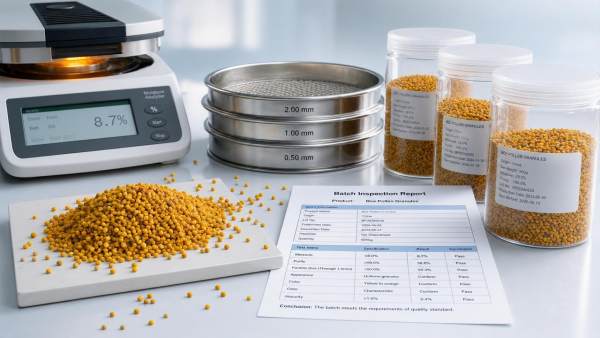
When sourcing bee pollen granules bulk for food, nutraceutical, or industrial use, visual appeal and low price are never enough. Purity, moisture, and supplier consistency shape product safety, shelf life, and batch stability.
In regulated supply chains, weak incoming control often causes bigger downstream problems. A clean-looking lot can still carry excess moisture, mixed-origin material, pesticide residues, or unstable granule sizing.
That is why bee pollen granules bulk should be evaluated like any other sensitive bio-extract ingredient. The goal is simple: reduce compliance risk and keep every batch predictable.
For sectors followed by AgriChem Chronicle, especially bio-extracts, feed processing, and fine chemical-adjacent applications, a stronger review process improves both technical confidence and supply chain transparency.
Start with the three markers that decide batch reliability
Before going deep into paperwork, focus on the three factors that most often separate a usable lot from a risky one: purity, moisture control, and repeatable supplier performance.
These three markers also connect directly to storage loss, microbial growth, processing behavior, and complaint rates. In practice, they tell more than color or aroma alone.
[Image 01: Laboratory inspection of bee pollen granules bulk with moisture analyzer, sieve test trays, and supplier batch documents on a QC bench]
A fast pre-screen helps, but it should lead to measurable checks. If one of these three markers is weak, the lot usually needs tighter review before release.
- Check whether bee pollen granules bulk contains visible foreign matter, broken debris, insect fragments, or blended fillers. A clean appearance should always be confirmed by sieve and microscopy review.
- Verify moisture with a defined method, not supplier claims alone. Excess water quickly raises clumping, mold risk, enzyme instability, and transport damage during long storage cycles.
- Review supplier consistency across at least three recent lots. Stable color, odor, moisture, particle size, and documents usually indicate stronger process control and lower hidden variability.
- Match test results to intended use. Food, nutraceutical, feed, and industrial blending lines may accept different limits, but incoming control criteria should remain written and repeatable.
Purity is more than “looks clean”
Purity assessment for bee pollen granules bulk should combine physical, botanical, and contamination checks. Many issues are not obvious in a simple visual inspection.
Mixed floral origin is not automatically a defect. The problem starts when the declared composition, contamination profile, or handling conditions cannot be verified with supporting evidence.
What to confirm in incoming purity review
- Ask for specification limits covering foreign material, ash, pesticide residues, heavy metals, and microbiology. If the sheet is vague, the lot is harder to defend during audits.
- Use sieve separation and visual sorting to estimate non-conforming particles. This simple step often catches husk fragments, dust overload, and excessive fines before full lab release.
- Confirm identity with microscopy or another suitable method when risk is higher. This matters when bee pollen granules bulk is used in high-value or sensitive formulations.
- Compare certificate values with internal spot tests. Repeated alignment builds trust, while frequent gaps usually signal unstable cleaning, drying, or lot segregation practices.
One common oversight is assuming “natural variation” explains every difference. Natural materials do vary, but wide swings in debris level or residue profile often point to weak harvest control.
Another blind spot is document recycling. If multiple lots carry nearly identical lab values across moisture, microbiology, and residues, the paperwork deserves closer scrutiny.
Moisture control decides storage safety faster than most teams expect
Moisture is one of the most practical risk indicators for bee pollen granules bulk. Even a good-quality lot can fail in storage if water activity or total moisture drifts too high.
The impact is rarely isolated. Higher moisture can change flowability, increase sticking inside liners, raise microbial pressure, and shorten usable shelf life during shipping or warehouse transfer.
How to check moisture without overcomplicating the process
- Use a fixed test method for every lot, such as loss on drying or validated moisture analysis. Trend data matters more when the same method is used consistently.
- Sample from top, middle, and bottom layers of each container. Moisture in bee pollen granules bulk may not distribute evenly after transit or poor sealing.
- Inspect packaging for liner damage, weak seals, or condensation marks. Physical pack failure often explains moisture gain better than the certificate alone.
- Set both acceptance and warning limits. A lot within release range may still deserve shortened storage time or tighter warehouse monitoring when trending upward.
In feed and ingredient handling environments, moisture drift can also change screening efficiency and blending uniformity. That makes the issue operational, not just microbiological.
Supplier consistency is where long-term risk usually shows up
A single acceptable batch does not prove a reliable source. The real test for bee pollen granules bulk is whether the supplier can repeat the same standard over time.
In complex agricultural and biochemical supply chains, consistency depends on harvest controls, drying discipline, lot segregation, traceability, and packaging practice. Documentation should reflect that reality.
Signals of a stable supply partner
- Lot records show clear harvest date, region, processing date, and batch coding. Good traceability helps explain variability instead of hiding it behind general statements.
- Specifications stay tight across multiple shipments, with reasonable but not identical values. Real process control looks consistent, not artificially copied from one report to another.
- Complaint handling is documented and timely. A reliable source of bee pollen granules bulk can explain root cause, corrective action, and preventive steps without delay.
- Packaging format, liner type, sealing method, and pallet protection remain standardized. Small packaging changes often create major differences in moisture retention and contamination risk.
If audit access is limited, trend analysis becomes even more important. Side-by-side comparison of three to six lots can reveal process drift before it turns into a nonconformance.
A few real-world situations where the review should get tighter
When bee pollen granules bulk is headed into encapsulation or powder blending, granule flow and moisture uniformity deserve extra attention. Small differences can disrupt filling performance and storage behavior.
When the material is used in feed or broader ingredient processing, packaging resilience and transit exposure become more critical. Long routes, humid ports, and container delays increase moisture-related loss.
If the lot comes from a new season or new origin, do not rely only on historical approval status. Seasonal shifts can change residue profile, granule structure, and drying stability.
If supplier testing was outsourced, verify the lab scope and method alignment. Third-party data is useful, but only when methods match the internal control framework.
A practical release approach that keeps decisions consistent
The simplest way to strengthen decisions is to use a fixed release sequence. That avoids overreliance on appearance and keeps bee pollen granules bulk evaluation easier to defend.
- Start with packaging condition, seal integrity, labeling accuracy, and temperature or humidity exposure signs. Physical condition often predicts whether deeper lab issues are likely.
- Move next to identity, purity, moisture, and microbiology according to internal risk ranking. Testing order should reflect the most probable failure points.
- Compare current results with historical lot trends before release. A passing number in isolation may still indicate supplier drift when compared with previous shipments.
- Document any concession clearly, including shelf-life adjustment, restricted use, or added monitoring. This keeps bee pollen granules bulk decisions traceable and operationally useful.
For organizations operating across food, nutraceutical, agricultural, and processing sectors, this kind of structured review supports the same transparency principles seen across AgriChem Chronicle coverage.
In the end, dependable bee pollen granules bulk is not identified by one attractive sample. It is proven through repeatable purity checks, disciplined moisture control, and supplier data that stays credible over time.
If the next lot is under review, begin with the last three batch records, confirm the moisture trend, and challenge any purity claim that lacks method-backed evidence. That single step usually improves decisions immediately.
Related Intelligence
- Natural IngredientsFreeze-Dried Fruit Ingredients: A Packaging Checklist for Bulk StorageBuying freeze dried fruit ingredients? Use this bulk packaging checklist to assess moisture barriers, seals, and pack sizes, reduce waste, and protect quality from storage to production.
- Natural IngredientsBotanical Ingredient Prices in Europe: Comparing Quotes by Grade and Order VolumeCompare Europe botanical ingredients price quotes by grade and order volume. Discover how potency, testing, delivery, and inventory costs reveal real savings before you buy.
- Natural IngredientsMayonnaise vs. Salad Dressing: Ingredient and Texture DifferencesMayonnaise vs. salad dressing: discover key ingredient, texture, stability, and application differences to choose the right product for every recipe.
The Morning Broadsheet
Daily chemical briefings, market shifts, and peer-reviewed summaries delivered to your terminal.
