

The Authority in Global Agricultural Chemistry & Bio-Resources
Freeze-Dried Fruit Ingredients: A Packaging Checklist for Bulk Storage
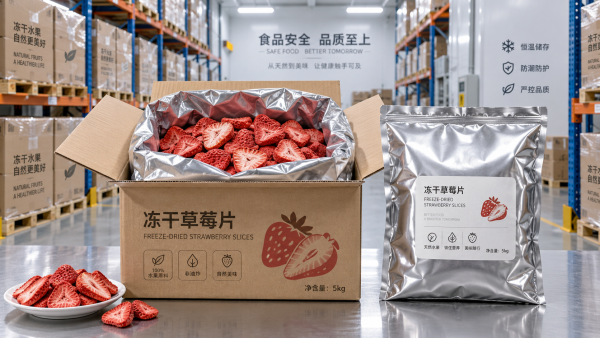
A bulk pack can arrive with an undamaged carton yet still fail on the production line: fruit pieces may have lost their crispness, powder may have formed lumps, or fragile inclusions may have broken during transport. For procurement teams, the packaging decision should cover more than bag material and purchase price. It should define moisture protection, seal integrity, mechanical protection, pack size, and the conditions under which the ingredient will actually be stored and used.
The practical starting point is a written packaging specification tied to the fruit format, delivery route, warehouse conditions, and consumption rate. Ask suppliers to distinguish demonstrated package performance from assumptions based on a film datasheet. A suitable barrier material is only one part of a suitable bulk package.
Start with the ingredient and its failure modes
Freeze-drying removes water through sublimation under reduced pressure and can preserve a porous structure. That structure helps explain why packaging deserves close attention: moisture uptake can change texture and handling characteristics, while fragile pieces may require protection against compression and vibration. The extent of these effects depends on the fruit, processing conditions, and final product format. Ratti’s review of high-value food drying discusses the process and associated quality characteristics.[1]
For freeze dried fruit ingredients, understanding how a fruit such as strawberry is processed helps buyers separate ingredient specifications from packaging requirements. Whole berries, slices, granules, and powders should not automatically share the same bulk-pack specification. A powder may be purchased for consistent dosing and dispersion; a visible inclusion may be purchased for shape, color, and texture.
Before comparing packaging quotations, define what makes the delivered ingredient unacceptable. For cereal inclusions, this might include excessive fines or loss of crispness. For a powdered drink ingredient, it might involve caking that interferes with feeding or mixing. Record the evaluation method and agreed acceptance criteria rather than relying on descriptions such as “good condition.”
Specify moisture protection with comparable evidence
Moisture-barrier selection should begin with the intended storage environment and shelf-life requirement. A supplier’s statement that a liner is “high barrier” does not establish whether it will protect the ingredient through a humid distribution route or an extended warehouse hold.
Request the complete laminate construction, including layer materials and thicknesses, together with water vapor transmission rate data. ASTM F1249 describes measurement of water vapor transmission through plastic film and sheeting using a modulated infrared sensor.[2] The reported test temperature, humidity conditions, and units matter: results obtained under different conditions are not directly interchangeable.
Film measurements also have limits. They describe the tested material, not necessarily the protection provided by the finished bag. Seals, folds, punctures, closures, and damage during packing or handling can create weaknesses that a flat-film test does not capture.
For oxygen-sensitive quality attributes, ASTM D3985 provides a method for measuring oxygen gas transmission through plastic film and sheeting using a coulometric sensor.[3] Oxygen-barrier performance should be a justified requirement, not an automatic addition to every purchase specification. Ask which product attribute it protects and what evidence supports the proposed limit.
Choose the package structure around handling conditions
Foil-containing laminates, metallized structures, and other multilayer films can offer different combinations of barrier performance, flexibility, puncture resistance, and cost. The material name alone is insufficient for selection. Buyers should compare the actual construction and its performance after conversion into the proposed bag.
The outer pack has a separate job. A corrugated carton, drum, or other rigid container may protect the liner from stacking pressure and handling damage, but it should not be assumed to provide the required moisture barrier. The specification should identify which component supplies environmental protection and which provides mechanical support.
Consider the packing geometry as well. Sharp folds, liner contact with rough container surfaces, and uncontrolled movement inside an oversized carton are potential damage points to assess during trials. For delicate pieces, ask whether the proposed fill weight and pallet configuration preserve the agreed particle-size distribution after delivery.
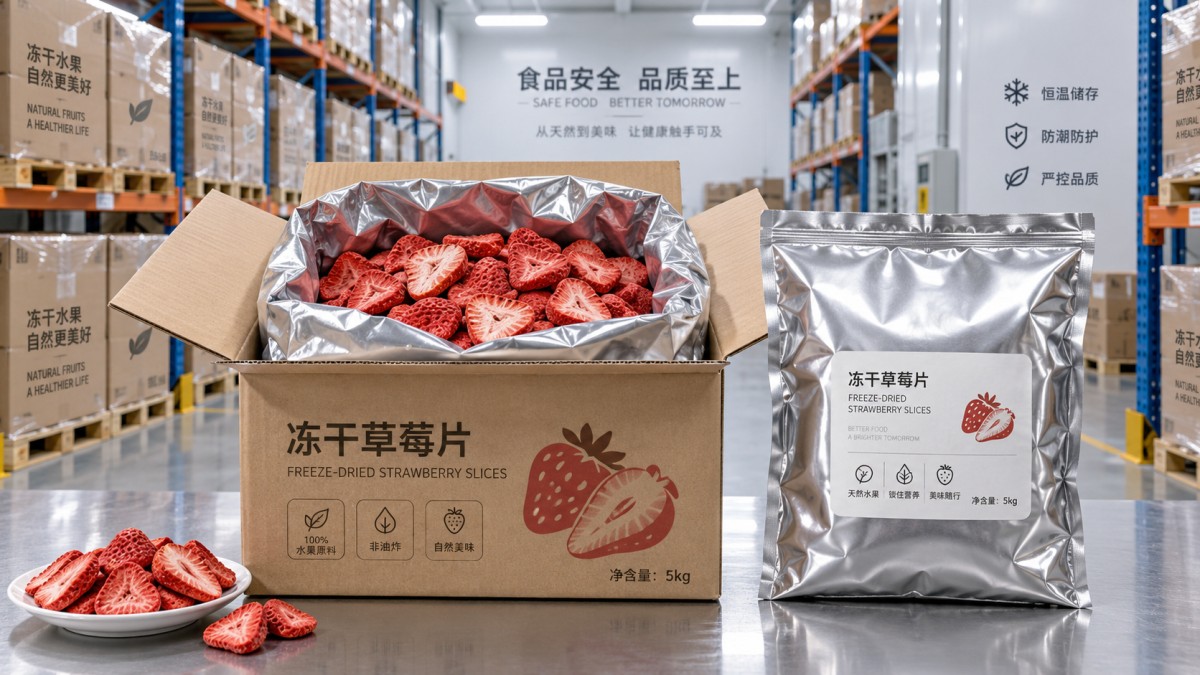
Transport trials should reflect the actual route as closely as practical, including pallet stacking, warehouse transfers, and the expected handling method. Examine both the package and the ingredient afterward. A bag that remains sealed may still contain an unacceptable proportion of broken fruit.
Treat seals, gas flushing, and sachets as separate decisions
A barrier liner needs a controlled closing process. Ask the packer to document the sealing setup, inspection procedure, and response to contamination or wrinkles in the seal area. Fruit dust near the closure should be addressed in the packing procedure rather than left to visual judgment at dispatch.
Seal strength and leak detection answer different questions. ASTM F88/F88M addresses seal strength of flexible barrier materials, while ASTM F2096 addresses detection of gross leaks by internal pressurization, commonly described as bubble testing.[4][5] Neither result alone demonstrates shelf life. The chosen methods must be suitable for the package, and acceptance criteria should be agreed before routine supply begins.
Nitrogen flushing, desiccants, and oxygen absorbers should be specified only where their intended function is clear. A gas-flushing proposal should identify the required residual oxygen condition, when it is measured, and how the result will be verified. It should not replace moisture-barrier or seal requirements.
If a supplier proposes a sachet, request its identity, suitability for the intended food-packaging use, retention arrangement, and removal instructions. Establish how the receiving and production teams will prevent it from entering the product stream. Its capacity and compatibility require product-specific justification; “included for freshness” is not a sufficient purchasing specification.
Make bulk pack size fit the production schedule
The lowest packaging cost per kilogram may come from a pack that is too large for practical use. Once opened, its original sealed-pack protection no longer describes the conditions experienced by the remaining ingredient. Procurement should therefore compare unopened storage life with the expected period between opening and complete consumption.
Map the proposed pack size against batch requirements. If one bag supplies several production runs, determine where it will be held between runs, how often it will be opened, and whether partial contents will be transferred. Smaller sealed inner packs may be preferable when consumption is intermittent, even if they increase packaging material and receiving work.
A zipper, clip, or folded liner should not be assumed to restore the original barrier. Require an agreed resealing procedure and a justified post-opening use period. If those conditions have not been evaluated, avoid assigning a precise open-pack shelf life.
- Pack size: Match it to practical batch consumption, lifting arrangements, and dosing equipment.
- Opening method: Specify how staff can open the liner without introducing packaging fragments.
- Partial-pack control: Define the container, closure, identification, storage location, and disposition of unused material.
- Internal labeling: Preserve lot identity when an outer carton is removed or contents are transferred.
Evaluate value as the cost of usable ingredient at the point of dosing. Include rejected material, excessive fines, residual contents, repacking labor, and disposal costs where relevant. These factors can change the apparent advantage of a cheaper bulk-pack quotation without requiring speculative savings estimates.
Separate shelf-life evidence from food-safety assurance
A quality-preservation package is not a microbiological control by itself. The Codex Code of Hygienic Practice for Low-Moisture Foods explains that pathogens can survive in low-moisture foods and emphasizes controls against contamination.[6] Low moisture content should therefore not be treated as proof of microbiological safety.
Ask for the supplier’s relevant food-safety controls and agreed microbiological specifications separately from packaging claims. Moisture content and water activity are also different measurements. If either is an acceptance parameter, specify the method, sampling arrangements, and product-specific limit rather than accepting an unexplained number on a certificate.
Shelf-life evidence should identify the ingredient, package construction, pack size, storage conditions, sampling schedule, and failure criteria. Check whether the evidence covers the proposed commercial pack or only a smaller laboratory sample. For procurement purposes, accelerated testing needs an explanation of how its results support the stated storage period; it is not automatically equivalent to observation under intended conditions.
Food-contact documentation must match the destination market and intended conditions of use. For U.S. applications, 21 CFR 174.5 establishes general provisions applicable to indirect food additives, with other relevant provisions or authorizations depending on the substances involved.[7] Request documentation covering the actual liner and relevant contact components, not just a generic statement that the packaging is “food grade.”
Turn the specification into a receiving checklist
The purchase order should reference an approved packaging specification, its revision, and the process for notifying the buyer of changes. A substitution in laminate, liner dimensions, closure system, or packing site should trigger review rather than being treated as an invisible purchasing adjustment.
Use the following checklist to connect supplier approval with routine receiving:
- Confirm identity: Match ingredient description, format, lot code, net weight, and packaging revision to the order.
- Inspect transport protection: Check cartons or drums for crushing, wetting, punctures, and signs of unstable stacking.
- Assess the liner: Apply the agreed sampling plan for seal condition, visible damage, and closure conformity.
- Review records: Check required certificates, storage instructions, and relevant packing or transport documentation.
- Check ingredient condition: Evaluate agreed attributes such as caking, texture, color, odor, and fines using defined methods.
- Resolve exceptions: Quarantine questionable lots and establish disposition before releasing them to production.
Warehouse instructions should translate the supplier’s storage conditions into workable rules: where pallets may be stored, how damaged packs are handled, and how opened material is identified. If chilled storage is proposed, agree on handling during temperature transitions and opening rather than assuming colder storage is always the better option.
The purchasing decision should rest on a package that protects the specified ingredient through the actual distribution and use cycle. Approve the complete system—liner, seal, outer pack, pack size, and handling procedure—and keep the evidence attached to the specification. That gives buyers a defensible basis for comparing offers and investigating failures.
Sources
- [1] Ratti, C. “Hot air and freeze-drying of high-value foods: a review.” Journal of Food Engineering, 49, 2001, pp. 311–319.
- [2] ASTM F1249, Standard Test Method for Water Vapor Transmission Rate Through Plastic Film and Sheeting Using a Modulated Infrared Sensor.
- [3] ASTM D3985, Standard Test Method for Oxygen Gas Transmission Rate Through Plastic Film and Sheeting Using a Coulometric Sensor.
- [4] ASTM F88/F88M, Standard Test Method for Seal Strength of Flexible Barrier Materials.
- [5] ASTM F2096, Standard Test Method for Detecting Gross Leaks in Packaging by Internal Pressurization (Bubble Test).
- [6] Codex Alimentarius, CXC 75-2015, Code of Hygienic Practice for Low-Moisture Foods.
- [7] U.S. Code of Federal Regulations, Title 21, Section 174.5, General provisions applicable to indirect food additives.
Related Intelligence
- Natural IngredientsFreeze-Dried Fruit Ingredients: A Packaging Checklist for Bulk StorageBuying freeze dried fruit ingredients? Use this bulk packaging checklist to assess moisture barriers, seals, and pack sizes, reduce waste, and protect quality from storage to production.
- Natural IngredientsBotanical Ingredient Prices in Europe: Comparing Quotes by Grade and Order VolumeCompare Europe botanical ingredients price quotes by grade and order volume. Discover how potency, testing, delivery, and inventory costs reveal real savings before you buy.
- Natural IngredientsMayonnaise vs. Salad Dressing: Ingredient and Texture DifferencesMayonnaise vs. salad dressing: discover key ingredient, texture, stability, and application differences to choose the right product for every recipe.
The Morning Broadsheet
Daily chemical briefings, market shifts, and peer-reviewed summaries delivered to your terminal.