

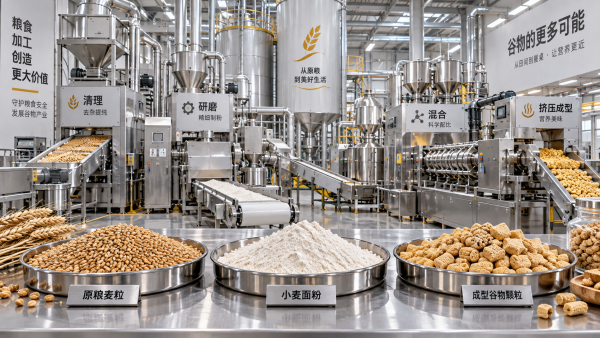
For grain producers, feed manufacturers, and industrial buyers, one question shapes equipment selection and product strategy: what is the difference between primary and secondary grain processing?
Primary processing typically prepares harvested grain through cleaning, drying, dehulling, and milling. Secondary processing converts grain or its fractions into foods, formulated feeds, and other products.
The practical distinction is purpose: primary operations establish usable raw materials, while secondary operations create specific product functions, recipes, or formats for a defined market.
Understanding that boundary helps buyers specify equipment, assess quality risks, and evaluate added value. However, terminology varies, so procurement decisions should always reference actual unit operations.
Primary vs. Secondary Grain Processing: The Practical Difference
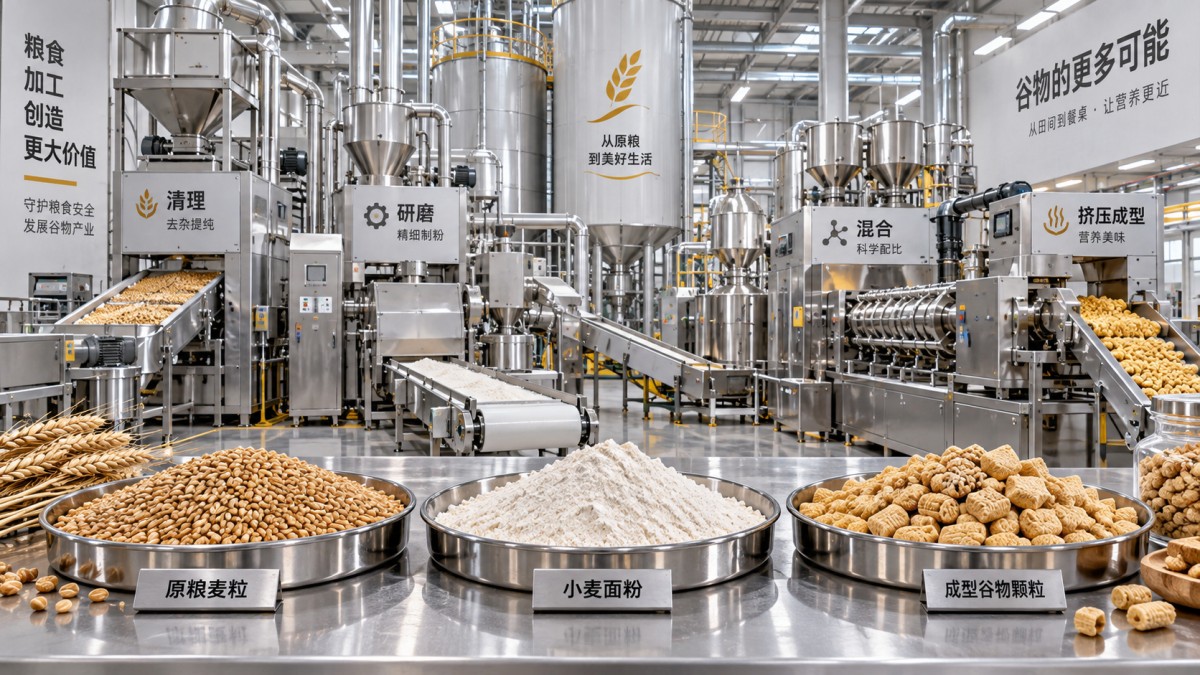
Primary processing usually changes grain cleanliness, moisture, outer layers, or particle size. Its outputs include cleaned kernels, brown rice, flour, meal, grits, and separated fractions.
Secondary processing generally uses those materials as ingredients. Mixing, fermentation, cooking, extrusion, and baking produce characteristics that simple cleaning or size reduction cannot achieve alone.
This distinction describes processing stages, rather than separate businesses. An integrated mill may perform both, while a specialist supplier may handle only one primary operation.
Neither stage automatically guarantees a safe or premium product. Outcomes depend on incoming grain quality, process control, sanitation, storage conditions, and the intended use specifications.
What Does Primary Processing Actually Deliver?
Primary processing begins by making variable agricultural material suitable for storage or manufacturing. The required sequence depends on grain species, harvest condition, and customer specifications.
Cleaning removes materials such as stones, straw, dust, and some damaged kernels. Screens, aspiration systems, magnets, and destoners address different contaminants and often work together.
Drying reduces moisture to a level appropriate for the grain, storage duration, and climate. Excessive drying temperatures can damage quality, including functionality needed for downstream manufacturing.
Dehulling removes the protective hull from grains such as rice and oats. Equipment settings influence kernel breakage, recovery, and the amount of residual hull material.
Milling reduces particle size or separates anatomical components. Wheat milling produces flour and bran streams, while maize milling can produce meal, grits, germ, and other fractions.
For buyers, the important deliverable is consistency against measurable specifications. Relevant measures may include moisture, foreign material, broken kernels, particle distribution, and flour extraction rate.
A lower purchase price can become expensive when inconsistent raw materials reduce throughput or yield. Compare accepted output and usable fractions, alongside the invoice price.
What Changes During Secondary Processing?
Secondary processing develops the properties required by the customer. Depending on the product, these include texture, flavor, digestibility, nutritional composition, shelf stability, and physical durability.
In bread production, flour is mixed with other ingredients, fermented, and baked. These steps transform milling output into a product with a distinct structure and use.
Breakfast cereal manufacturing may combine mixing, cooking, extrusion, drying, and coating. Process settings determine expansion, density, crispness, and how the product behaves during storage or serving.
Compound feed production typically combines milled ingredients with protein sources, minerals, vitamins, and other components. Conditioning and pelleting may follow to achieve the required physical form.
Feed quality involves more than pellet appearance. Buyers may need to assess nutrient uniformity, fines generation, pellet durability, and suitability for the target species and life stage.
Secondary processing therefore adds formulation and functional performance to raw-material preparation. Its value depends on meeting a saleable specification consistently, at an acceptable total production cost.
Packaging supports that outcome but does not define the stage by itself. Bagging flour remains different from transforming flour through fermentation, cooking, or baking into food.
Where Does the Boundary Become Ambiguous?
Some operations resist a simple classification because terminology differs across textbooks, industries, and jurisdictions. Milling, flaking, malting, and starch extraction may be grouped differently by context.
For example, crushing grain for a feed ingredient is commonly treated as primary processing. Combining that ingredient into a formulated ration generally belongs to secondary processing.
Rolling grain can simply alter its physical dimensions. Steam flaking also applies moisture and heat, potentially changing starch availability; its classification depends on the framework used.
Malting includes controlled germination and drying, creating biochemical changes beyond straightforward cleaning or milling. Describing those operations explicitly is more useful than debating a universal label.
Wet milling separates grain into fractions such as starch, protein, and germ. Subsequent starch modification or fermentation introduces further transformation, with different technical and commercial requirements.
During procurement, specify the input, operation, output, and acceptance criteria. A supplier’s description of a “secondary processing line” is insufficient without a defined process flow.
How Does the Distinction Affect Equipment Selection?
Begin with the required output and work backward. A cleaner, dryer, or mill should be selected against incoming grain variability and the specification it must achieve.
For primary equipment, examine throughput under realistic conditions, separation efficiency, kernel damage, adjustment range, wear parts, and accessibility for inspection, cleaning, and routine preventive maintenance.
For secondary equipment, focus on process control and product flexibility. Recipe management, dosing accuracy, temperature control, residence time, and changeover requirements can determine commercial performance.
Nameplate capacity rarely describes the entire line. A mill’s output may exceed dryer capacity, while cooling or packaging can limit an otherwise capable secondary operation.
Ask suppliers to define operating assumptions behind capacity claims. Grain moisture, particle size targets, formulation, and acceptable quality losses can materially change the achievable production rate.
Trials should use representative materials, including expected variability. Record accepted output, rejects, energy consumption, and stoppages rather than relying solely on a short demonstration run.
Also verify utility requirements and integration costs. Steam, electrical supply, compressed air, dust extraction, buildings, and controls can substantially change the installed cost of equipment.
Which Quality and Safety Risks Need Separate Controls?
Primary processing concentrates on raw-material acceptance and physical preparation. Sampling plans should address the hazards relevant to the grain, origin, storage history, and intended destination.
Cleaning and sorting can reduce some contamination, but they do not reliably eliminate mycotoxins. Drying limits further deterioration under suitable conditions; it does not remove existing toxins.
Milling may redistribute contaminants among fractions. Assess food and feed streams individually, including by-products, against applicable specifications and legal limits in the destination market concerned.
Secondary processing introduces additional risks through ingredients, handling, and formulation. Allergen cross-contact, dosing errors, recontamination, and unsuitable time-temperature conditions may require dedicated preventive controls and verification.
A thermal step should only be treated as a microbial control when validated for the relevant product and hazard. Cooking or pelleting alone does not establish validation.
Dust accumulation and combustible dust hazards also deserve attention across both stages. Equipment layout, extraction, housekeeping, ignition control, and applicable engineering standards need coordinated consideration.
Requirements differ by product and jurisdiction. Identify applicable food or feed obligations, traceability expectations, and customer standards instead of assuming one certification covers every operation.
Batch records should connect received grain lots with processing results and dispatched products. This supports investigations, targeted recalls, supplier evaluation, and resolution of customer quality complaints.
Does Secondary Processing Always Offer Better Returns?
Secondary processing can increase revenue per tonne, but additional selling price is not the same as additional profit. Ingredients, energy, labor, packaging, and distribution consume margin.
Primary processing can also create substantial value through improved recovery, reduced storage losses, consistent grading, or access to customers requiring a reliable, tightly specified ingredient.
Compare options using the same incoming-grain basis and realistic saleable yield. Include all product streams, disposal costs, and the actual market value of usable by-products.
A practical calculation subtracts grain, other ingredients, utilities, labor, maintenance, packaging, and waste costs from product revenue. Then account for fixed costs, financing, and working capital.
Evaluate capacity utilization separately. A specialized extrusion line may generate attractive contribution margins during production yet perform poorly financially when demand leaves it idle for long periods.
Market access matters equally. A flour supplier needs dependable ingredient customers, while a cereal or feed producer must meet product requirements and maintain suitable sales channels.
Before investing, test sensitivity to grain prices, energy costs, yield, selling prices, and downtime. Favor projects whose economics remain acceptable under plausible adverse conditions as well.
How Should Buyers Define a Processing Project?
A useful project specification connects commercial demand with measurable technical requirements. It should make clear what enters the line, what leaves it, and what constitutes acceptance.
- Define the target product, customer, destination market, and required output specifications.
- Characterize incoming grain quality, seasonal variability, expected volumes, and storage conditions.
- Map each operation, material stream, bottleneck, and required utility.
- Specify quality controls, relevant hazards, traceability, and verification requirements.
- Agree on performance trials, sampling methods, acceptance limits, and supplier responsibilities.
- Compare total ownership cost and commercial demand before committing capital.
For an existing plant, prioritize the constraint that most affects accepted output or customer performance. Improving cleaning, drying, or dosing may outperform a larger expansion project.
For a new venture, validate demand before choosing technology. Product trials, customer specifications, and realistic purchasing commitments provide stronger investment evidence than broad value-added market claims.
Supplier comparisons become clearer when every quotation follows the same scope. Include installation, commissioning, operator training, consumables, spare parts, service support, and agreed guarantees where appropriate.
Choosing the Right Stage for Your Business
Primary grain processing prepares grain and produces usable fractions. Secondary grain processing develops those materials into products with defined recipes, structures, functions, or end-use characteristics.
The right investment depends on your customer and operational constraints. Primary improvements can strengthen yield and consistency; secondary capabilities can open markets when demand supports additional complexity.
Use the distinction to organize decisions, then specify actual operations and measurable outcomes. Reliable inputs, controlled processes, verified quality, and viable economics determine whether processing adds value.