

The Authority in Global Agricultural Chemistry & Bio-Resources
How Poultry Feeding Trough Design Affects Feed Spillage
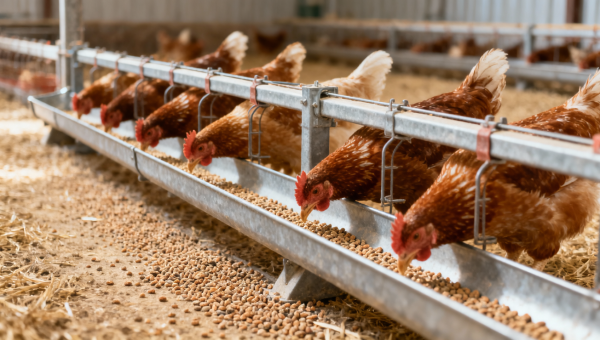
Feed scattered beneath a poultry trough is not always a sign that birds are eating more than they need. The loss may begin with a rim they can sweep feed over, a feed level that is too deep, or a feeder that no longer matches the birds’ size. Trough design also affects whether feed remains accessible and clean: a modification that catches more material can be counterproductive if it restricts access or creates a place where damp feed accumulates.
For farm managers and equipment buyers, the useful question is not simply which trough has the highest sides or the largest capacity. It is how the rim, internal depth, access openings and mounting height work together under the actual feeding conditions. Bird age, flock size, feed form and cleaning practices all influence the result.
Where spillage begins
Birds move feed with their beaks as they eat. In an open trough, that movement can push particles toward the edge; feed close to the top has little distance to travel before it falls out. Birds may also compete for space, step into an accessible trough or disturb the contents when entering and leaving the feeding area. The design cannot eliminate every movement, but it determines how easily those movements turn into losses.
Some material under a feeder may come from filling, leaks at joints or a misaligned delivery outlet rather than from the birds themselves. Distinguishing these sources matters. Raising a lip will not correct a split seam, and reducing the fill level will not necessarily solve a trough that rocks when birds lean on it.
Spilled feed can be difficult to distinguish from litter once it is dispersed. Feed on the floor may become contaminated with bedding, droppings or moisture, so its potential recovery should not be assumed. The immediate concern is the feed lost; the secondary concern is whether the same design also makes cleaning and inspection harder.
How the trough profile controls feed movement
When assessing a feeding trough for poultry, it helps to look at the complete cross-section rather than a single advertised dimension. Sidewall height, the shape of the lip, the depth of feed and the width of the eating space determine both how easily a bird can reach feed and how far it can move that feed before it escapes.
Rim height and shape
A low rim gives birds easy access but offers little resistance to sideways movement. A taller sidewall can retain feed more effectively, provided birds can reach over it comfortably. If the side is too high for the smallest birds using the equipment, feed may remain in the trough while access becomes uneven.
An inward-facing lip can help redirect some feed back into the trough. Its usefulness depends on its projection and the bird’s approach angle. An overly deep return can obscure the feed, interfere with the head or neck, and make corners harder to inspect. The lip should be judged with the feeder installed at its intended height, not only as a loose component on a workbench.
Bottom width, depth and internal corners
A wide, shallow base spreads feed over a larger area, which can make it accessible but also exposes more material to movement. A narrow or deep channel may contain feed better, yet birds may struggle to reach material remaining at the bottom or along the far side. The right balance depends on the bird and whether the trough is replenished manually or supplied continuously.
Internal corners deserve attention because they affect both feed flow and cleaning. Smooth transitions can make residue easier to remove, while tight folds, overlapping joints or deep recesses may retain fines. A rounded profile is not automatically superior in every installation; the practical test is whether feed stays reachable during normal use and whether the entire food-contact surface can be cleaned.
Guards, grids and access openings
Bars or a grid above the trough can discourage birds from stepping into the feed and may reduce some side-to-side movement. They also divide the available space. Openings that suit larger birds may offer little restraint for smaller ones; openings that are too restrictive can impede feeding or leave some parts of the trough unused.
Check the clearance between the guard and the rim as well as the opening itself. A guard should remain secure when birds press against it, while allowing staff to inspect the feed and remove accumulated material. If it must be detached for cleaning, its fixings should be accessible without damaging the trough.
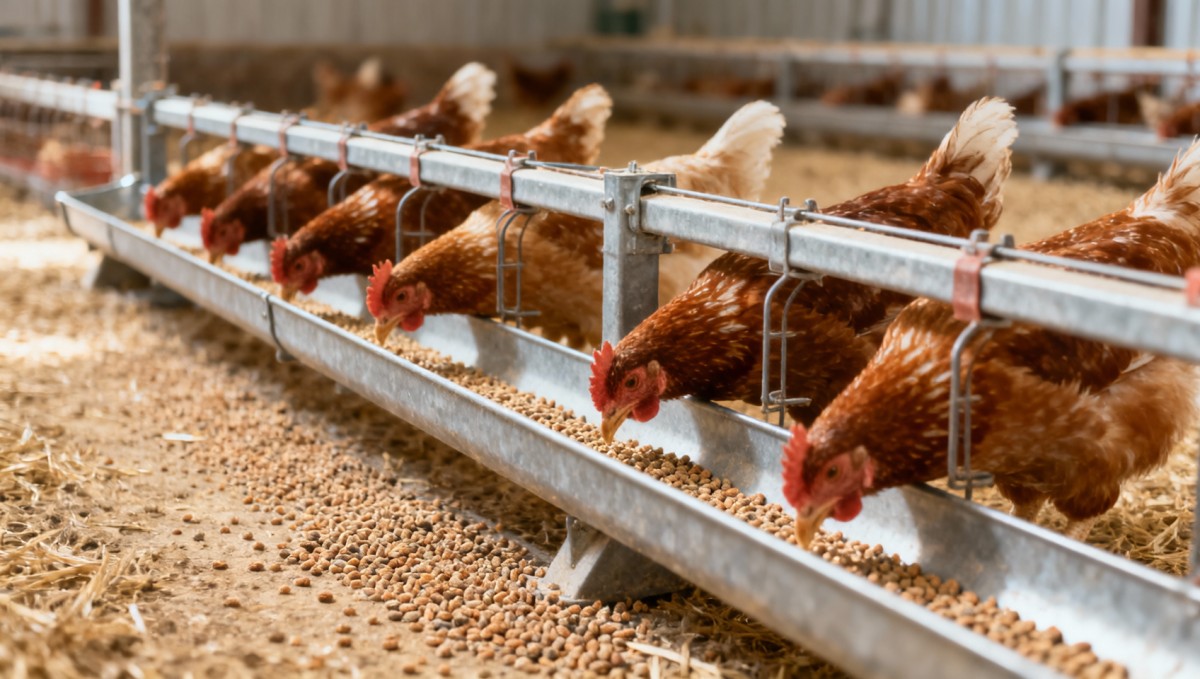
Sizing checks: match the bird, not just the house
Trough length is often selected from flock capacity, but effective access depends on more than overall length. End plates, support brackets, corners and guards can reduce the usable section. A long trough that is crowded at one end and ignored at the other may have a placement or distribution problem rather than a simple shortage of equipment.
Observe the flock during a normal feeding period. Birds should be able to approach and withdraw without persistent obstruction, and smaller individuals should have reasonable access. Crowding, repeated displacement or birds reaching awkwardly over one another are reasons to review feeder space and layout. They do not, on their own, identify a single cause: feed availability, bird distribution and management routines can contribute.
Height needs particular attention as birds grow. A trough set low enough for young birds can become easy for larger birds to rake or step into. Set too high, it can limit access, especially for smaller birds. Adjustable supports are useful only if they can be secured reliably and staff can change them without leaving the trough tilted. Follow the bird-management guidance applicable to the flock and verify the setting by observing the birds at the feeder.
For a straight trough, check that the mounting height remains consistent along its length. A sagging center or uneven floor can change access and allow feed to collect in one area. Where feed is delivered into a long trough, look at distribution after filling and again after birds have eaten: a full inlet end and an empty far end call for a delivery adjustment, not simply a larger trough.
Feed level and delivery can outweigh a good rim
The fill level changes the effective containment depth. Even a well-shaped sidewall provides limited protection if feed is piled close to the edge. Conversely, keeping the trough nearly empty may reduce material available to be spilled but can leave birds competing for access or cause interruptions in feeding.
Choose a working level that keeps feed within reach without leaving a loose ridge against the lip. The appropriate level will vary with the trough profile, feed form and delivery method. Observe what happens immediately after refilling as well as later in the feeding cycle; an average level can conceal a brief overflow at the delivery point.
Feed form also changes the way material behaves. Mash, crumbles and pellets differ in particle size and flow. Fine material can collect in seams or be carried out with bird movement, while larger particles may roll or accumulate differently. A trough that performs acceptably with one ration should be checked again when feed form changes. Avoid attributing every increase in fines beneath the feeder to the trough: handling and delivery can also affect the material arriving there.
Material and construction affect daily losses
Metal and plastic troughs can both be suitable when their construction matches the environment and cleaning routine. The useful comparison is not material name alone, but whether the finished surface stays intact, the trough holds its shape and joints remain closed in service.
A flexible section that bows under feed load can alter the rim profile or pull away from a connector. A damaged edge may allow feed to escape and can present an injury hazard. Metal components should be checked for corrosion or damaged coatings where moisture and cleaning agents are present. Plastic components should be inspected for cracks, distortion and wear around supports or fasteners. Replacement decisions should consider whether individual sections and fixings are available and can be fitted without creating gaps.
At joints, examine the underside as well as the interior. A seam may appear sound from above while releasing a thin stream of feed during filling. End caps, outlet connections and mounting holes deserve the same scrutiny. Small leaks can be missed when birds are active but become visible when the trough is filled and left undisturbed for a short observation period.
Cleaning checks that protect trough performance
A design that retains feed should also permit removal of old feed and residue. Buildup can change the usable shape of the channel, interfere with feed flow and hide defects. Moisture makes inspection especially important because damp residue may adhere to corners and joints.
The cleaning method should follow the equipment manufacturer’s instructions and the farm’s hygiene procedures. Before cleaning, isolate or stop the feed delivery equipment as appropriate and remove accessible feed. If water or a cleaning agent is used, confirm that it is suitable for the material and that the trough can be thoroughly dried before feed is returned. Avoid directing moisture into motors, electrical components or inaccessible joints.
Use a repeatable inspection route rather than checking only the visible surface:
- Before cleaning: note where residue has accumulated and whether feed is lodged behind guards, lips or end caps.
- During cleaning: check that brushes or other approved tools can reach the full food-contact surface without bending the rim or damaging a coating.
- After cleaning: inspect seams, fasteners and supports for cracks, corrosion, looseness or remaining residue.
- Before refilling: confirm that removable parts are secure, the trough is dry where required, and delivery outlets align with the channel.
Ease of disassembly is a trade-off. A removable guard may expose hidden surfaces, but loose or complicated fasteners can slow routine work and may be reassembled incorrectly. Evaluate the cleaning procedure with the trough mounted in its intended position, including any clearance needed to remove parts.
A practical way to diagnose excess feed under a trough
Start by separating fresh spillage from older feed mixed with litter. Observe a refill, then watch a representative feeding period. Record whether material falls from the delivery outlet, through a joint, over the rim or when birds enter the area. A simple sketch of the locations can be more useful than treating the entire feeder line as one problem.
Change one manageable condition at a time where flock care permits. For example, correct a visible leak before judging rim performance, or adjust a tilted support before changing the fill level. Recheck access after every adjustment: a reduction in feed on the floor is not a satisfactory result if birds cannot feed comfortably or feed remains unreachable in the channel.
When comparing equipment, ask for the dimensions of usable feeding space, the range of mounting adjustment, the materials and the recommended cleaning method. Confirm how trough sections connect, how guards are removed and which parts may need replacement. A sample or installed demonstration can reveal whether the lip, openings and internal surfaces suit the actual birds and feed better than a capacity figure alone.
The most reliable assessment combines containment with access, structural stability and cleanability. A trough should be judged across the feeding cycle and as the flock grows, because a setting that works at installation may need adjustment as bird size, feed behavior or equipment condition changes.
Related Intelligence
- Feeding & Watering SystemsFeeder and Drinker Placement in Deep-Litter Poultry HousesUse this poultry house planning guide to optimize feeder and drinker placement, improve bird access, reduce wet litter, and simplify maintenance.
- Feeding & Watering SystemsHow Poultry Feeding Trough Design Affects Feed SpillageDiscover how a feeding trough for poultry can reduce feed spillage. Explore practical tips on rim design, feeder height, access and cleaning.
- Feeding & Watering SystemsChoosing a Livestock Feeding Systems Exporter: Delivery and After-Sales SupportChoose a livestock systems exporter with reliable delivery, clear installation terms, and responsive after-sales support. Discover what to check to reduce downtime and protect your investment.
The Morning Broadsheet
Daily chemical briefings, market shifts, and peer-reviewed summaries delivered to your terminal.
