

The Authority in Global Agricultural Chemistry & Bio-Resources
Commercial Neoprene Chest Waders: Choosing Thickness and Grip for Cold-Water Fishing
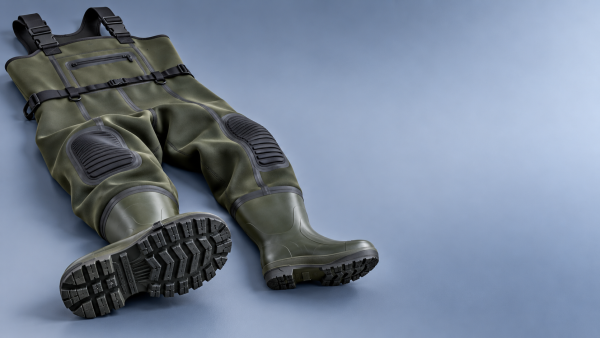
Choose commercial neoprene chest waders by matching insulation to time spent in cold water, then selecting a sole for the actual riverbed and access route. A thicker suit suits prolonged, low-movement work, while a lighter construction often performs better when fishing involves frequent walking, climbing, or hauling. Neither choice compensates for poor boot fit or an outsole that loses traction on the surfaces underfoot.
A useful specification therefore starts with the coldest routine task, the longest uninterrupted immersion, and the most difficult footing. Water temperature alone cannot determine the right thickness: current, weather, physical effort, clothing, and individual cold tolerance all affect comfort. Treat nominal neoprene thickness as a starting point for comparison, then assess the complete wader under representative conditions.
Choose thickness around immersion and movement
Neoprene insulates through its closed-cell foam structure. Increasing thickness generally increases resistance to heat loss, but also adds bulk and resistance to movement. The effect becomes noticeable during deep knee bends, stepping over obstacles, and repeated movement between a boat and the bank. A suit that feels comfortable while standing in a showroom can become tiring during a working shift.
Common thickness descriptions include 3 mm, 4 mm, and 5 mm. These labels are useful for sorting options, but they do not establish a universal water-temperature rating. Foam formulation, panel construction, fit, and the layers worn underneath affect the result. Hydrostatic pressure also compresses neoprene as immersion depth increases, reducing its insulating thickness; surface measurements do not describe every operating condition.
For a route involving a long approach followed by stationary fishing, assess both phases separately. Heavy insulation that feels appropriate in the water can cause sweating during the approach. Because neoprene waders release little moisture through the material, damp clothing can then feel cold when activity stops. Managing layers and opening the upper garment during dry access travel helps, provided water entry is not a concern.
Mixed-thickness construction deserves closer examination. Thicker lower panels and more flexible upper sections can suit work dominated by leg immersion, but the specification should identify where each thickness is used. An advertised maximum thickness says little about warmth if it applies only to small reinforced areas.
Boot fit can overturn the insulation choice
Cold feet do not automatically indicate that the neoprene body is too thin. Tight boots, compressed socks, insufficient sole insulation, and long periods without movement can produce similar complaints. Adding thicker socks inside an already tight boot reduces toe space and can impair circulation. The fit assessment must include the intended sock system, with enough room to move the toes and maintain loft.
Bootfoot waders simplify dressing and remove the need to lace a separate boot. Their limitation is the relationship between body size and boot size: a suitable chest and inseam do not guarantee a suitable foot fit. Separate size combinations become valuable when standard pairings produce either excessive body bulk or cramped feet.
Stockingfoot waders allow independent boot selection and more adjustment around the ankle. They also introduce a sizing requirement: the boot must accommodate the neoprene stocking and socks without compression. Assess heel hold on an incline and foot movement during a deliberate step. Excess internal movement causes instability even when the outsole itself grips well.
Select grip for the surface beneath the water
Traction changes with substrate, surface film, and the direction of loading. A sole that holds while walking forward may slide during a sideways reach or when turning with a load. Separate the route into submerged footing and access surfaces before choosing an outsole. Muddy banks, rounded gravel, algae-coated rock, timber steps, and boat decks place different demands on the same pair of waders.
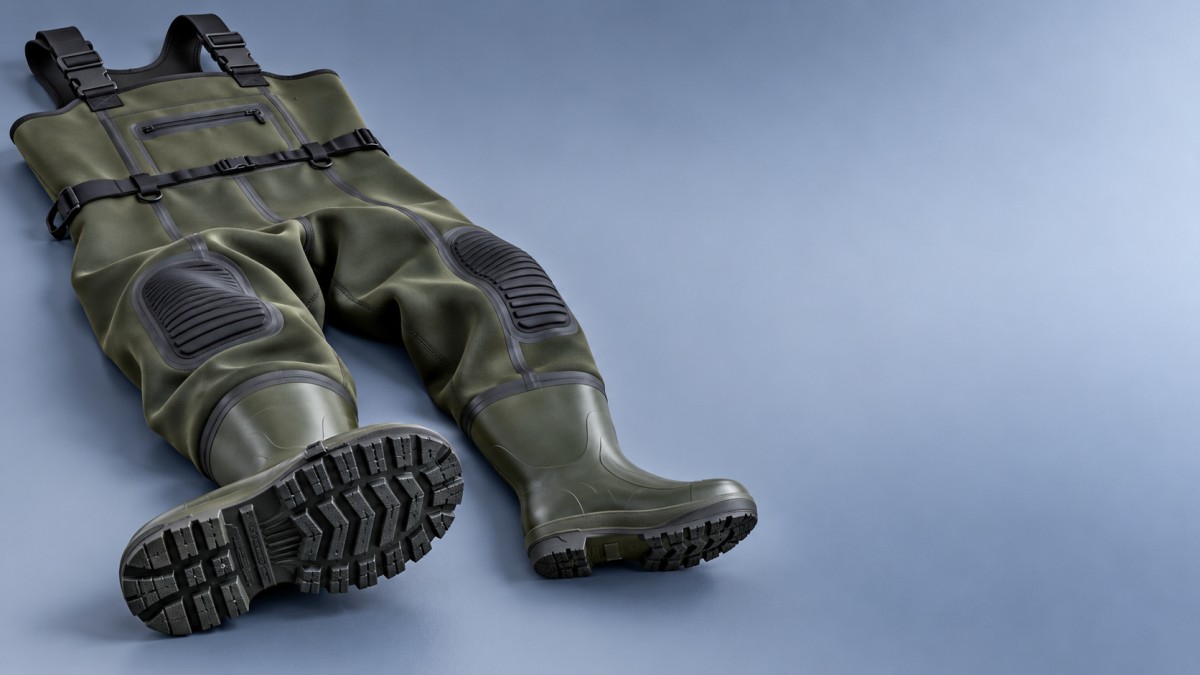
Rubber tread for mixed routes and soft ground
Rubber outsoles are a practical starting point where travel includes banks, tracks, gravel, and boat access. Open lugs provide edges that engage soft ground and spaces through which loose material can escape. Closely packed tread that fills with mud loses much of its useful profile. Examine the outsole after walking through the actual sediment, rather than judging tread depth alone.
On smooth, algae-covered rock, aggressive lugs do not necessarily produce reliable grip. The contact surface, rubber compound, and biological film become more influential than the visual depth of the pattern. Product descriptions such as “non-slip” offer little decision value without a named test surface and method. Results from clean flooring should not be assumed to represent a submerged riverbed.
Felt where wet rock dominates
Felt soles often provide useful traction on wet rock because the fibers conform to surface irregularities. Their limitations become apparent on muddy slopes, snow, and some access structures, where the material offers little penetration or collects debris. A route dominated by rock can still make felt unsuitable if the entry and exit involve steep soil banks.
Local restrictions and site biosecurity rules also affect selection. Felt and other absorbent components retain moisture and debris, complicating cleaning between waters. Confirm permitted footwear before ordering, and make sure the cleaning and drying process is practical for the intended turnaround. Rubber footwear also requires cleaning; changing sole material does not remove the need for contamination control.
Studs for specific contact conditions
Studs provide concentrated contact points that help on some hard, uneven surfaces, but their performance depends on placement, protrusion, and the material beneath them. Excessive protrusion can reduce rubber contact and create an unstable feel on flat, hard surfaces. Studs also require compatibility with boats, deck finishes, and inflatable components.
For removable systems, establish whether the sole is designed to accept studs and whether retention remains secure after repeated flexing. Improvised fasteners risk penetrating unsuitable sole structures or loosening during use. Where routes alternate between rock and vulnerable deck surfaces, a dedicated footwear arrangement may be more workable than one permanently studded pair.
Construction details that change service performance
Thickness does not describe seam integrity. Neoprene panels are commonly joined using adhesive and stitching, with sealing or reinforcement added according to the design. Ask how the seam is made waterproof, especially at the crotch, seat, knees, and boot junction. Stitching alone is not evidence of a waterproof joint, and an external strip does not reveal the quality of the bond beneath it.
The boot-to-leg connection deserves particular attention because it flexes repeatedly and experiences leverage when a foot sticks in mud. Examine the transition for sharp folds, uneven bonding, and edges likely to catch. During a sample trial, repeated crouching and stepping should not pull the upper material tight against this joint.
Reinforced knees and seats help where contact abrasion is predictable. Their value depends on coverage and flexibility: a small patch can miss the actual contact zone, while a stiff overlay can concentrate bending along its edge. Try kneeling and climbing in the intended size. Reinforcement should follow the movement without creating a hard crease or dragging adjacent seams.
Chest height, suspenders, and body length also influence performance. An overly short rise pulls at the shoulders during crouching; excessive length gathers at the knees and complicates movement. Suspenders should hold the garment without carrying constant tension from an undersized body. A wading belt helps limit water movement into the legs after an accidental entry, but chest waders are not flotation equipment.
Use a sample trial to separate warmth, leakage, and condensation
A useful trial reproduces a demanding routine task: the access walk, normal immersion depth, stationary fishing, and the return route. Record water and air conditions, clothing, activity, and exposure time so that comparisons remain meaningful. Testing different suits with different socks or substantially different workloads makes the result difficult to interpret.
Assess movement before entering the water. Include a high step, a controlled crouch, kneeling, and the actual boat or bank transition where relevant. Restriction often comes from sizing or seam placement rather than thickness alone. A slightly more flexible 5 mm construction can feel easier to move in than a poorly cut thinner suit.
During immersion, distinguish localized cold from general cooling. Cold toes with a comfortable torso point toward boot fit or foot insulation. Broad discomfort after a long inactive period suggests that total insulation or exposure management needs attention. A traction trial should use controlled footing with support available, not deliberate slips on hazardous terrain.
Dampness requires separate diagnosis. A small wet patch recurring beside one seam suggests a leak, while widespread moisture after strenuous walking suggests perspiration. These patterns are clues, not proof. Dry the garment fully and use the manufacturer's leak-testing method to locate defects. Avoid improvised high-pressure inflation or filling the garment with heavy volumes of water, which can stress seams.
Write the specification around a complete configuration
A usable purchase description identifies more than “5 mm neoprene waders.” It records panel thicknesses, bootfoot or stockingfoot construction, the required size combinations, outsole type, reinforcement locations, and the seam-sealing method. For insulated boots, distinguish the stated insulation material or weight from any claimed temperature rating; insulation weight alone does not establish whole-boot thermal performance.
Keep acceptance criteria observable. Suitable criteria include unrestricted movement through the agreed tasks, secure foot fit with the specified socks, no water entry during an agreed leak test, and acceptable traction on identified surfaces. A sample that performs well on gravel does not establish suitability for algae-covered rock. Retain the tested configuration so later deliveries can be compared against it.
Service arrangements matter where they affect continued use. Confirm whether punctures, seam leaks, and boot-junction damage are repairable, which adhesives are compatible with the material, and how long repairs must cure. Cleaning should remove grit from folds and tread; drying should reach the interior before storage. Heat sources used to accelerate drying can damage adhesives or components, so follow the garment's care instructions.
If no configuration handles both the coldest stationary task and the most active access route comfortably, separate wader specifications for those tasks are justified. Record the operating limits revealed by the trial alongside the selected thickness and sole, so the approved garment remains tied to the conditions in which it was evaluated.
Related Intelligence
- Commercial FishingRussia Plans 15% Cut to 2027 Fisheries Development BudgetRussia plans a 15% cut to its 2027 fisheries development budget, bringing it to RUB 18.7 billion. Explore potential impacts on fleet renewal, aquaculture and future seafood supply.
- Commercial FishingCommercial Neoprene Chest Waders: Choosing Thickness and Grip for Cold-Water FishingChoose commercial neoprene chest waders with confidence. Compare thickness, boot fit, and sole grip to find the right setup for cold-water fishing and demanding work.
- Commercial FishingEuropean Commission Pledges Simpler Aquaculture Rules and Clearer Funding DetailsEuropean Commission pledges simpler aquaculture rules and clearer funding guidance. Explore what the 2040 Vision could mean for compliance, investment and business planning.
The Morning Broadsheet
Daily chemical briefings, market shifts, and peer-reviewed summaries delivered to your terminal.