

The Authority in Global Agricultural Chemistry & Bio-Resources
Aquaculture System Technologies: Comparing Ponds, Flow-Through, and RAS
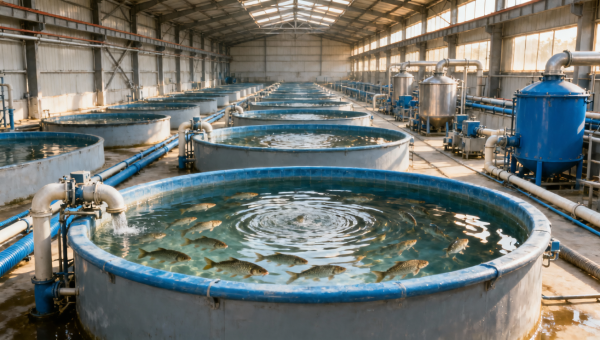
Choose ponds where suitable land, dependable water, and seasonal production fit the business model. Favor flow-through systems where an adequate water supply maintains acceptable temperature and chemistry throughout the production cycle. Consider recirculating aquaculture systems (RAS) where water availability, temperature control, or discharge constraints justify greater equipment intensity and continuous process supervision. The selection should follow the site's limiting conditions and the species' requirements, rather than a preferred technology.
Comparing aquaculture systems technologies requires a common production basis: the same species, harvest size, annual saleable output, and seasonal delivery schedule. A pond designed around seasonal harvests and an indoor RAS designed for continuous production perform different jobs. Their capacity, cost, and reliability figures become meaningful only after those differences are reconciled.
Start with the constraints that can eliminate an option
Water assessment should establish usable supply during the most restrictive period, including competing demand, drought, and intake interruptions. An annual average conceals the conditions that determine stocking limits. Source-water testing should cover temperature, dissolved oxygen, suspended solids, pH, alkalinity, and contaminants relevant to the catchment. Groundwater also requires attention to dissolved gases and treatment needs before contact with stock.
Species requirements narrow the choice further. Temperature tolerance, swimming behavior, oxygen demand, sensitivity to suspended solids, and tolerance of crowding all influence the necessary tank or pond environment. A species that survives a broad temperature range does not necessarily grow economically across that range. Production planning should use conditions that support feeding, growth, and acceptable welfare throughout the intended cycle.
Ponds: productive capacity follows the oxygen cycle
Ponds combine culture space with biological processes that transform nutrients and, in some production models, supply natural food. Their apparent simplicity conceals a changing oxygen balance. Photosynthesis produces oxygen during daylight; respiration by fish, plankton, and other organisms continues overnight. Consequently, an acceptable afternoon oxygen reading does not establish that conditions will remain acceptable before dawn.
Aeration capacity must account for standing biomass, feeding, water temperature, and the oxygen demand of decomposing organic matter. Prolonged cloudy conditions or a bloom collapse can reduce the margin available. Backup arrangements should address the equipment needed during these events, including its power supply and accessibility during severe weather.
Soil and civil design strongly affect operating performance. Permeable soils increase seepage unless sealing or lining is effective. Pond bottoms that fail to drain retain sludge and standing water, complicating harvest, cleaning, and preparation between crops. Aerator placement also matters: circulation that improves oxygen distribution may leave solids accumulating in poorly swept areas.
Ponds suit production plans that accommodate environmental variability and sufficient land area. They become harder to justify when tight temperature control, frequent grading, or highly predictable year-round harvests dominate the specification. Comparisons should include land preparation, water conveyance, drainage, harvesting arrangements, and sediment management alongside pond construction.
Flow-through: evaluate the source at its weakest point
Flow-through systems replace culture water continuously, carrying oxygen into the production units and removing metabolic waste. Gravity-fed layouts can reduce pumping demand where elevation and available head are sufficient. That advantage depends on actual hydraulic losses through screens, pipework, treatment equipment, and culture units, including conditions when surfaces become fouled.
Available flow alone does not define production capacity. The oxygen delivered depends on both flow and the difference between inlet oxygen concentration and the minimum acceptable outlet concentration. Warmer water holds less oxygen while fish oxygen demand often increases within their active temperature range. A source that supports the planned biomass in cool conditions may become restrictive during warmer periods.
Water arrangement changes the assessment. With parallel supply, each unit receives source water. In serial raceways, downstream units receive water already affected by upstream respiration and waste production. Supplemental oxygen can relieve an oxygen constraint, but it does not remove accumulated carbon dioxide, ammonia, or suspended solids. Those limits require separate calculations.
Discharge treatment must match both the volume and character of the effluent. Large water flows can create substantial hydraulic demands even where pollutant concentrations appear modest. Concentration measurements should therefore be assessed alongside total mass discharged. Intake screening, sediment removal, and isolation provisions also need to accommodate seasonal debris, flooding, and source-water contamination.
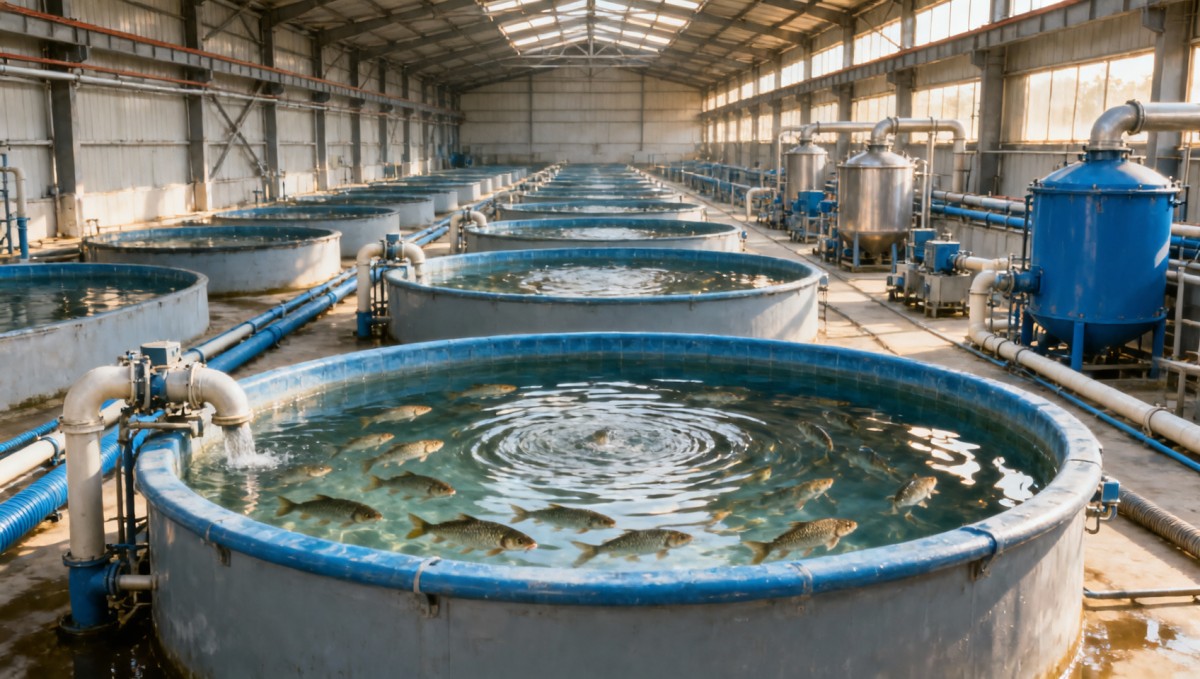
RAS: specify treatment capacity around feeding
RAS treats and reuses water through a combination of solids removal, biological filtration, gas management, and circulation. Makeup water remains necessary to replace losses and control substances that the installed treatment train does not adequately remove. A high recirculation percentage does not establish low total environmental impact or suitability for a particular species.
Maximum daily feed input is a more useful treatment design basis than tank volume alone. Feeding drives oxygen consumption, ammonia production, carbon dioxide generation, and solids loading. Two installations with identical tank volumes can have very different treatment requirements because their biomass, fish size, feed composition, and feeding schedules differ.
Mechanical filtration should remove feces and uneaten feed before prolonged circulation breaks them into smaller particles. Tank hydraulics, outlet design, and pipe velocities influence whether solids reach the filter promptly or settle within the system. A filter's nominal flow rating does not establish performance under the expected solids load, and finer screening introduces backwashing and maintenance demands.
Biofilters convert ammonia through nitrification, consuming oxygen and alkalinity in the process. Their performance depends on temperature, pH, oxygen availability, loading, and the condition of the microbial community. A newly commissioned biofilter cannot be assumed to support the final feeding rate immediately. Stocking and feeding increases need to follow demonstrated treatment performance.
Gas management deserves separate attention. Adequate dissolved oxygen does not prove that carbon dioxide is controlled, particularly where supplemental oxygen supports high biomass. Carbon dioxide stripping and oxygen addition serve different functions. Designs should also address the energy balance: building insulation, makeup-water temperature, ventilation, and heat released by equipment influence heating or cooling demand.
RAS concentrates production into a tightly connected process. A circulation failure or oxygen interruption can affect a large biomass quickly. Redundancy must cover credible failure modes: a spare pump offers little protection if it shares the failed electrical supply or blocked suction. Emergency oxygen, backup power, alarm transmission, and accessible isolation valves need coordinated design and commissioning tests.
Compare water, waste, and disease pathways together
Each system moves waste differently. Ponds retain part of the nutrient load in biomass and sediment, with releases occurring through overflow, water exchange, drainage, or sludge removal. Flow-through facilities export waste continuously unless treatment intercepts it. RAS captures a concentrated solids stream while dissolved substances remain subject to biological conversion, additional treatment, or water replacement.
These differences change the evidence needed for environmental assessment. Clear water is not proof of a low nutrient load, and low discharge volume does not establish that the receiving environment can accept the effluent. The evaluation should identify where solids, nitrogen compounds, cleaning water, and mortalities leave the production process and how each stream will be handled.
Biosecurity follows water connections and animal movement. Open ponds face exposure through incoming water, wildlife, and shared equipment. Flow-through systems remain connected to upstream conditions. RAS allows greater control over incoming water, but a pathogen introduced into a shared loop can circulate among connected tanks. Separate cohorts and treatment loops provide meaningful separation only when equipment, drainage, and working practices preserve it.
Make cost comparisons reflect the production schedule
Capital estimates should use a consistent boundary. Pond earthworks without drainage infrastructure, flow-through raceways without intake protection, and RAS tanks without oxygen storage are incomplete comparisons. Civil works, electrical supply, water treatment, monitoring, commissioning, and emergency systems all belong within the scope where required for operation.
Operating costs should be expressed per unit of saleable production, using realistic survival, growth, downtime, and harvest assumptions. Energy per kilogram depends on equipment efficiency and how much output shares the standing energy demand. Pumps, treatment systems, and environmental controls can continue consuming energy during partial stocking, quarantine periods, or delayed sales.
Utilization assumptions deserve particular scrutiny in RAS because much of the infrastructure operates continuously. Ponds require attention to seasonal downtime and preparation between crops. Flow-through economics are sensitive to pumping head and any treatment needed at the intake or discharge. A gravity-fed facility and a pumped installation should not inherit the same energy assumptions.
A useful sensitivity analysis varies the conditions most likely to change the choice: available source flow, electricity cost, achievable feeding rate, temperature extremes, and interrupted production. Applying identical percentage adjustments to every cost category obscures the physical causes of uncertainty.
Turn the preferred option into a verifiable specification
A technical proposal should state the operating conditions behind its capacity claim. The essential basis includes species, biomass, maximum daily feed, temperature range, source-water quality, oxygen limits, and the expected condition of discharged water. Treatment guarantees without these conditions are difficult to evaluate or verify.
Acceptance testing should connect equipment performance to biological loading. Hydraulic tests establish flow distribution and drainage; instrumentation tests establish measurement and alarm behavior. Biological commissioning then demonstrates that water quality remains within the agreed operating envelope as feed loading increases. A successful clean-water circulation test establishes only part of operational readiness.
The preferred design should also identify the response to a defined interruption, such as loss of source flow or primary power. That response needs a practical time basis, supported by emergency capacity and demonstrated alarm delivery. Where the proposed production target requires conditions the site cannot reliably sustain, reducing the target or changing the system is more defensible than assuming equipment ratings will close the gap.
Related Intelligence
- RAS SystemsAquaculture Filter Installation Costs: Plumbing, Labor, and CommissioningUnderstand aquaculture filter installation cost, from plumbing and labor to commissioning. Compare complete project scopes, uncover hidden expenses, and budget confidently before you buy.
- RAS SystemsAquaculture System Technologies: Comparing Ponds, Flow-Through, and RASCompare aquaculture systems technologies—ponds, flow-through, and RAS—to assess water needs, costs, and risks. Discover which system best fits your site and production goals.
- RAS SystemsSustainable Aquaculture Practices That Cut Feed Waste and Protect Fish Farm Water QualitySustainable aquaculture for fish farms: reduce feed waste, protect water quality, and build resilient, efficient systems with practical strategies.
The Morning Broadsheet
Daily chemical briefings, market shifts, and peer-reviewed summaries delivered to your terminal.