

The Authority in Global Agricultural Chemistry & Bio-Resources
Engineered RAS Systems: Designing Modular Farms Around Stocking Density
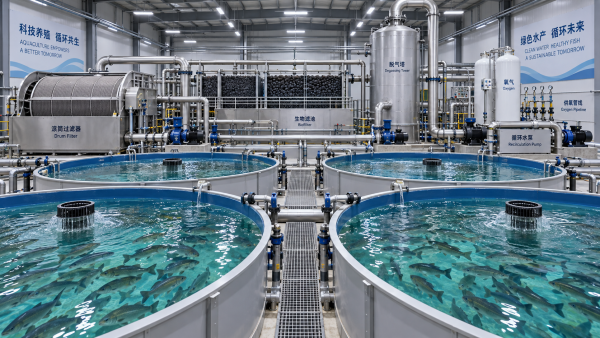
Stocking density is not a production target that can be selected at the end of a recirculating aquaculture system design. It is the loading condition that determines nearly every major engineering decision: the number and volume of tanks, daily feed capacity, hydraulic turnover, solids capture, biofilter surface area, oxygen transfer, carbon dioxide stripping, standby power, and the practical limits of farm expansion.
An engineered RAS system can operate reliably at a stated biomass only when its treatment train has been sized for the feed load, metabolic load, and failure conditions associated with that biomass. A modular farm designed around realistic density is therefore more valuable than a large single-loop facility designed around an optimistic density assumption. The former can be commissioned, validated, and expanded in controlled increments. The latter can turn one error in water-quality assumptions into a farm-wide operational constraint.
Density must be translated into engineering loads
Fish biomass per cubic metre is visible and easy to communicate, but it is not the primary input for process design. Two systems carrying the same standing biomass can impose very different loads if they differ in species, fish size, water temperature, feed formulation, feeding rate, oxygen demand, or harvest schedule.
The more useful starting point is a production model that converts the intended stocking plan into daily feed input and peak feed events. Feed is the practical driver of the major waste streams in RAS:
- uneaten feed and faecal solids determine mechanical separation and sludge handling demand;
- protein metabolism produces total ammonia nitrogen, which sets biofilter capacity and alkalinity consumption;
- respiration consumes oxygen and generates carbon dioxide, defining oxygenation and degassing requirements;
- feed decomposition and fish activity affect fine solids, dissolved organics, foam fractionation needs, and microbial pressure.
This distinction matters because density can be misleading during project approval. A tank may be described as operating at a moderate biomass density while fish are near harvest size, yet the daily feed rate may be high enough to push oxygen, CO2, solids, or biofiltration close to design limits. Conversely, a hatchery or nursery may hold a substantial fish count with a lower total feed load. The engineering question is not simply “how many kilograms per cubic metre?” It is “what water treatment duty occurs during the highest credible feeding and biomass period?”
Design teams should model at least three operating conditions: routine production, expected peak biomass with full feeding, and an upset condition in which one critical component is unavailable. The peak case should include realistic feed distribution through the day rather than treating feed as a perfectly even 24-hour load. Short, high-intensity feeding windows can create local ammonia, oxygen, and solids challenges that average daily calculations obscure.
Choose the production module before sizing the whole farm
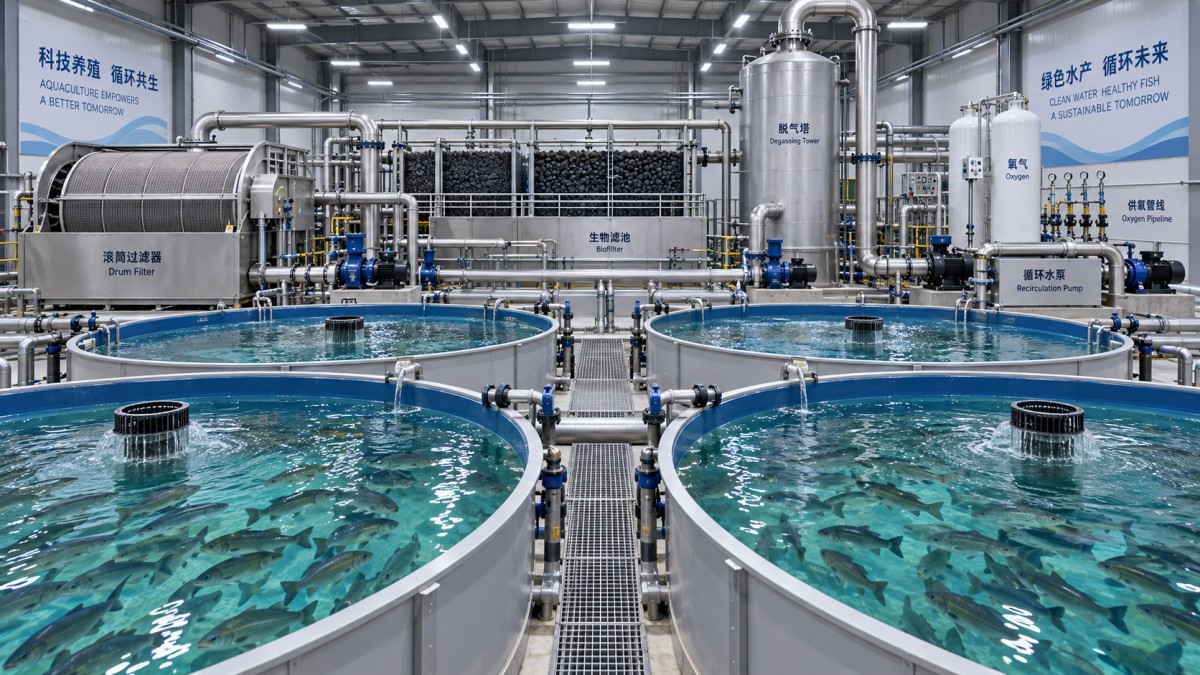
A modular RAS farm is not merely a collection of identical tanks. A workable module is an independently manageable production unit with a defined biological capacity and a treatment loop that can maintain water quality within its operating envelope. It may contain a group of grow-out tanks, drum filtration, biofiltration, degassing, oxygenation, pumps, ultraviolet or ozone treatment where justified, control instrumentation, and emergency provisions.
The correct module size is usually shaped by biological segregation and operational containment as much as by construction efficiency. A very large common loop can reduce duplicated equipment, but it also ties multiple tanks to the same water-quality event, pathogen pathway, maintenance outage, and commissioning risk. A smaller module creates more equipment interfaces, yet isolates failures and allows phased learning before later capacity is installed.
Modules should be based on a production cohort or a deliberately defined group of cohorts. Mixing fish of very different sizes in one water loop complicates feeding, grading, treatment decisions, and harvest logistics. It can also distort loading assumptions: smaller fish may need different flow velocities and feeding frequencies, while market-size fish may dominate oxygen demand and waste production.
A practical planning sequence is to define the harvest rhythm and crop cycle, calculate the biomass curve for each cohort, identify the maximum daily feed load in each module, and then size process equipment around that load with a documented operating margin. Only after this exercise should total annual output be aggregated across modules. Reversing the sequence—starting with an annual tonnage target and then dividing tanks to fit a building—often produces awkward hydraulic circuits and treatment plants that are difficult to expand without disrupting live production.
Tank layout affects water quality long before water reaches the filter
Tank geometry, inlet arrangement, outlet design, and elevation relationships directly influence the load presented to downstream equipment. Circular tanks are commonly used because a correctly designed tangential inlet can support rotational flow and direct settleable solids toward a central drain. That result is not automatic. Inadequate inlet energy, poorly placed drains, unsuitable tank slope, or flow rates chosen only to meet turnover targets can leave solids circulating in the culture water.
For density-driven design, the tank must remove solids quickly enough to limit particle fragmentation and nutrient release. Fine particles are harder for mechanical filters to capture and can increase turbidity, gill irritation, microbial activity, and biofilter fouling. The engineering objective is not maximum velocity throughout the tank; excessive velocity can stress fish or raise energy demand. It is a flow field that supports species-appropriate swimming conditions while carrying settleable waste to a dedicated removal point.
Dual-drain arrangements deserve particular attention in intensive systems. Separating a concentrated bottom-drain flow from the larger side-drain flow allows solids-rich water to receive immediate treatment without sending the whole recirculating volume through the same high-intensity solids pathway. This can reduce hydraulic burden on mechanical filtration and preserve cleaner water for downstream processes. The value depends on tank design, solids characteristics, and operating discipline, but the principle is clear: waste should be concentrated and removed as close to its source as the system layout permits.
Hydraulic design also needs to account for distribution, not just total flow. Parallel tanks require balancing so that one tank does not receive substantially less exchange or lower dissolved oxygen than its neighbours. Pipe diameters, head losses, valve settings, manifold geometry, and water-level control all matter. A nominal system turnover rate has little meaning if hydraulic short-circuiting allows a portion of the water to bypass treatment repeatedly while another portion receives inadequate exchange.
Biofiltration and oxygen systems need independent design margins
Biofilters are often discussed in terms of ammonia conversion capacity, but their reliable operation depends on more than media volume. Nitrifying organisms require oxygen, stable pH and alkalinity, acceptable temperature, adequate mixing, and protection from excessive solids. A biofilter sized only from a theoretical ammonia conversion rate can become a project bottleneck when feed rates rise, alkalinity dosing is inconsistent, or suspended solids accumulate.
Moving-bed biofilm reactors and fixed-media systems each require design choices that match the hydraulic configuration and maintenance plan. The central decision is not which technology has the highest advertised capacity. It is whether the selected reactor can maintain biological performance under the farm’s expected feed profile and can be isolated, inspected, or serviced without placing the entire module at risk.
Alkalinity supply should be treated as a process requirement rather than a minor chemical input. Nitrification consumes alkalinity and lowers pH. If dosing equipment is undersized, poorly mixed, or not integrated with reliable monitoring, pH instability can reduce biofilter performance at the same time that fish are exposed to more stressful water conditions. Storage, containment, dosing redundancy, and operator-safe chemical handling need to be incorporated in the plant layout from the beginning.
Oxygenation requires equally careful separation between average and peak demand. Oxygen consumption rises with feeding activity, biomass, temperature, fish movement, and stress. The oxygen system should be designed around credible peak consumption and the delivery capacity at each tank, not merely total oxygen available at a central source. A bulk oxygen tank, oxygen generator, low-pressure oxygen distribution system, cones, diffusers, or low-head oxygenators can all be part of an effective design, but each arrangement has different pressure, control, and redundancy implications.
Carbon dioxide management is the paired constraint. Increasing oxygen concentration does not solve poor CO2 removal; it can conceal the problem until fish performance deteriorates. Degasser loading, air-to-water contact, blower capacity, fouling, humidity, room ventilation, and water temperature all affect actual stripping performance. Where intensive density is planned, dissolved CO2 measurement and alarm strategy should be specified as explicitly as dissolved oxygen measurement. Relying on visual fish behaviour is not an adequate control method for a high-biomass module.
Design for the failure that turns density into a hazard
At low biomass, equipment loss may be recoverable with time to intervene. At high biomass, the same event can become critical quickly. The risk profile changes as density increases because oxygen reserves are consumed faster, CO2 accumulates more rapidly, and a circulation interruption can leave individual tanks without adequate exchange.
Redundancy should therefore be allocated according to consequence, not applied uniformly to every component. Pumps, oxygen supply, electrical power, controls, alarm communications, and essential make-up water arrangements typically deserve explicit single-failure analysis. The question is not whether a component has a backup, but whether the backup can deliver the required flow, pressure, oxygen dose, or control response under peak biomass conditions.
For example, a standby circulation pump is of limited value if its duty point has not been checked against actual pipe losses with filters partially loaded. A generator is not a complete contingency measure if automatic transfer, fuel autonomy, ventilation, and priority loads have not been defined. A cylinder manifold can protect oxygen supply, but only if reserve capacity, switching logic, and distribution pressure at distant tanks remain adequate.
Isolation is another form of resilience. Each module should allow a tank, pump, filter, biofilter segment, or oxygenation device to be taken out of service with a known operational response. Full isolation of every item may be impractical, but the project should identify which maintenance activities require reduced feeding, temporary density reduction, bypass treatment, or scheduled downtime. These constraints influence commissioning plans and future expansion more than equipment catalogues suggest.
Phased expansion works only if the first phase anticipates later phases
Modular construction can protect capital by allowing production performance to be validated before the farm reaches full intended capacity. It also creates a common trap: phase one is built as a complete but isolated facility, while future modules require later demolition, undersized utility upgrades, or disruption to operating fish.
The initial civil and utility design should reserve corridors, pipe penetrations, drainage capacity, electrical switchgear space, oxygen storage access, control-network capacity, sludge management area, and water-treatment interfaces for future modules. This does not mean installing all equipment on day one. It means avoiding irreversible site constraints that make later expansion expensive or biologically disruptive.
Shared infrastructure needs particularly careful treatment. Freshwater intake, make-up water treatment, discharge handling, sludge thickening, backup generation, and oxygen storage may be shared across modules, but their capacities must be staged deliberately. If central infrastructure is sized only for phase one, expansion can produce a bottleneck outside the culture hall even when each new RAS loop is correctly engineered.
Commissioning should also follow the modular logic. A new biofilter needs maturation before it receives a full production load. Hydraulic balancing, sensor validation, emergency oxygen testing, alarm testing, and process-control tuning should occur before biomass rises. Introducing fish into an incomplete or unproven treatment loop to meet a construction schedule is one of the clearest ways to convert a manageable commissioning task into a biological risk.
Density targets should remain operating envelopes, not promises
The most robust engineered RAS systems treat stocking density as an operating envelope bounded by water quality, fish welfare, feeding performance, equipment condition, and response capability. The upper end of that envelope should not be assumed at first stocking. It should be reached only after the module demonstrates stable performance across normal production variation, including warm-water periods, peak feeding, solids removal cycles, and equipment maintenance.
This approach changes how project capacity is communicated. Instead of presenting a single biomass figure as proof of farm capability, the design basis should show the relationship among standing biomass, feed rate, turnover, oxygen demand, CO2 removal, biofilter load, and emergency capacity. That documentation gives engineering, operations, finance, and permitting teams a common reference point and makes later changes easier to evaluate.
Modularity does not remove the complexity of intensive aquaculture. It makes that complexity more controllable. When each production unit is engineered around a defined loading envelope—and when expansion preserves the hydraulic, utility, and biosecurity logic of the first unit—the farm can grow without allowing density to outrun its capacity to maintain water quality and protect fish.
Related Intelligence
- RAS SystemsHow to Vet Middle East Oxygenation System Suppliers for RAS ProjectsOxygenation system suppliers Middle East: learn how to vet RAS partners for proven performance, resilience, local service, and lifecycle value.
- RAS SystemsEngineered RAS Systems: Designing Modular Farms Around Stocking DensityEngineered RAS systems designed around stocking density: explore modular farm design, water-quality control, resilience, and scalable growth.
- RAS SystemsHow to Select an Ammonia Water Quality Sensor for Aquaculture SystemsAmmonia water quality sensor selection guide for aquaculture: compare technologies, accuracy, salinity compatibility, maintenance, and integration for reliable monitoring.
The Morning Broadsheet
Daily chemical briefings, market shifts, and peer-reviewed summaries delivered to your terminal.
