

The Authority in Global Agricultural Chemistry & Bio-Resources
Choosing Fish Hatchery Equipment: Capacity and Water Quality Factors
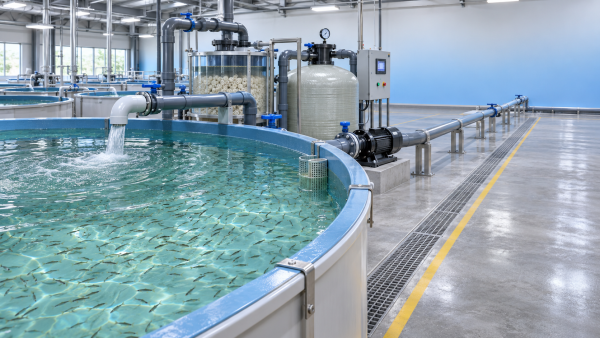
Select fish hatchery equipment for aquaculture by working backward from the number of fish required at each life stage and the water conditions needed to keep them healthy. A tank’s volume or an incubator’s egg rating gives only part of its capacity. The limiting component may instead be oxygen transfer, water exchange, solids removal, temperature control, or the ability to maintain flow during a pump failure.
Size the system for the most demanding combination of biomass, feed input, incoming water conditions, and production overlap. Then verify that every component can operate together at that point. Equipment that performs adequately during incubation may become undersized when feeding begins and waste production rises.
Translate production targets into simultaneous loads
Start with the number of eggs or juveniles required per batch, the intended batch schedule, and the expected time spent in each production unit. Calculate how many batches will occupy the hatchery at the same time. Separate eggs, newly hatched larvae, first-feeding fish, and larger juveniles: each stage has different space, flow, and water quality requirements.
Use survival and growth assumptions that are supported by the species, stock, and operating history where available. A production target stated only as fish per year conceals the peak demand on individual tanks. For example, two batches that overlap briefly can require nearly twice the holding space of a single batch, even though annual output has not changed. Cleaning and disinfection between batches also occupy equipment time and affect the number of units needed.
For growing fish, calculate biomass as the number of fish multiplied by their average weight. Repeat the calculation for the largest expected fish before transfer, and consider size variation within the group. A tank that holds the intended number at stocking can exceed its biomass or hydraulic limits before harvest. Feeding rate matters as well: it links fish growth to oxygen demand and to the solids and dissolved nitrogen entering the water.
Stocking density is useful only when expressed with its basis and operating conditions. Biomass per unit of tank volume does not reveal whether oxygen reaches the fish evenly or whether waste accumulates on the bottom. Compare density figures alongside tank geometry, water exchange, species behavior, feeding rate, and the location of water inlets and outlets.
Match incubation equipment to the egg and larval stage
Egg size, buoyancy, stickiness, and sensitivity to movement determine whether trays, baskets, jars, or other incubation vessels are suitable. A vessel must hold the planned egg load while allowing water to reach the eggs throughout the mass. Crowding can leave poorly flushed areas even when the total flow entering the incubator appears sufficient.
Review flow distribution as well as the nominal flow rate. Too little circulation permits sediment and metabolic waste to accumulate; excessive velocity can damage eggs or larvae, or carry them against screens. Adjustable flow, accessible valves, and screens sized for the smallest stage provide more useful control than a single fixed setting.
The transition from hatching to first feeding deserves its own layout review. Determine where larvae collect, how they move out of the incubator, and whether they can be transferred without excessive handling. Screen openings that retain eggs may clog with debris after hatching, while openings suited to larger fish may allow larvae to escape. Access for removing dead eggs and cleaning surfaces also affects how consistently water moves through the unit.
Size water flow around the limiting condition
Required flow is driven by several constraints at once: oxygen replenishment, carbon dioxide removal, dilution of dissolved wastes, temperature stability, and the velocity tolerated by the fish. The highest flow required by any one of these constraints sets a starting point. The final design must also account for how water is distributed within each vessel and how it reaches the drains.
For a flow-through system, assess the water source at its least favorable credible condition, including seasonal changes in temperature, dissolved oxygen, suspended solids, and available flow. A source that meets demand during a cool period may deliver less oxygen or require more treatment when it is warm. Intake screens, settlement, filtration, and disinfection add hydraulic resistance and require maintenance without interrupting supply.
For a recirculating system, distinguish the flow through fish tanks from the rate of replacement with fresh water. Recirculation reduces make-up water demand, but the treatment train must remove or transform the wastes that dilution would otherwise carry away. Confirm that each tank receives its required flow when filters are dirty, valves are adjusted, and water is being supplied to other tanks.
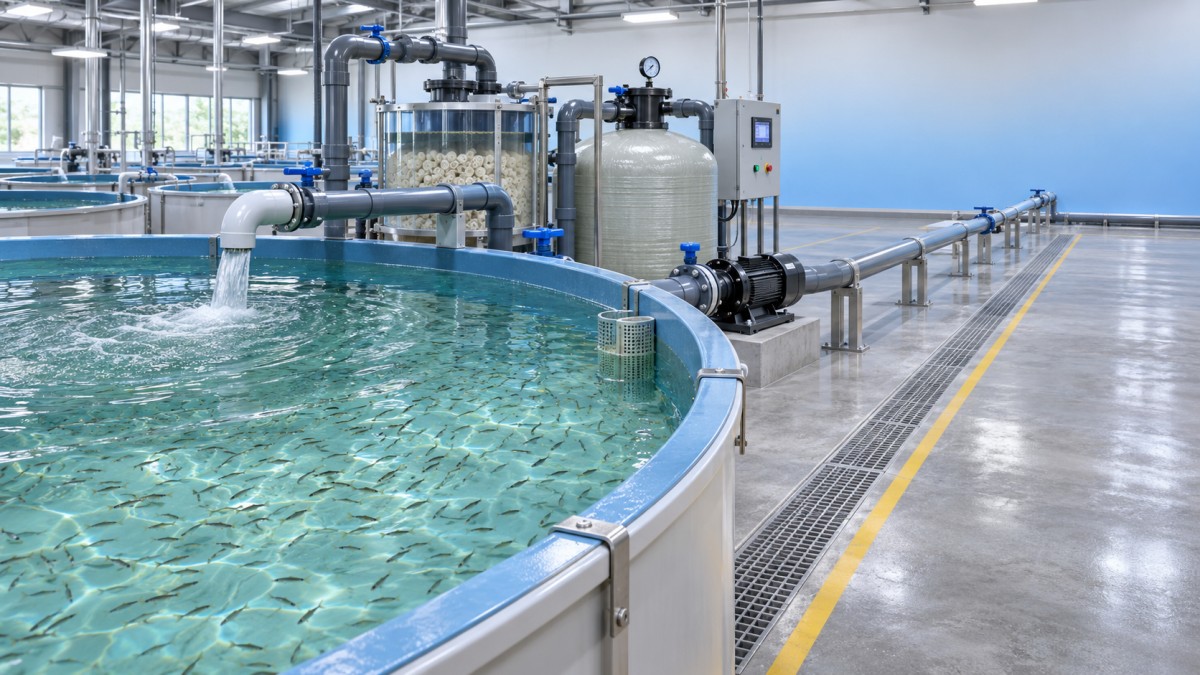
Pump curves need to be evaluated against the complete system, including elevation, pipework, fittings, screens, and treatment equipment. A pump’s maximum advertised flow is measured at a different operating point from the flow delivered against actual resistance. Include the expected increase in pressure loss between cleaning intervals, and verify that drains can carry the same operating flow without raising tank levels or creating a backwater.
Oxygen capacity must cover peak demand and distribution
Oxygen demand rises with biomass, feeding, and temperature, while the amount of oxygen water can hold falls as temperature increases. Size aeration or oxygenation for the highest credible demand at the lowest acceptable inlet oxygen concentration, rather than for average daily conditions. Include demand from biological treatment and other connected processes where they draw from the same oxygen budget.
Equipment ratings require context. An oxygen transfer figure established under controlled test conditions does not automatically describe performance in a working hatchery. Water depth, diffuser condition, salinity, temperature, mixing, and the oxygen concentration already present all affect transfer. Request the conditions behind the rating and the expected performance at the intended operating point.
Measure dissolved oxygen where fish experience it, especially near the outlet or in areas with weak circulation. A satisfactory reading close to an inlet or diffuser can coexist with a low reading elsewhere. Oxygen supersaturation, where it occurs, also warrants attention; excessive dissolved gas pressure can harm fish even when an oxygen reading looks favorable.
Backup arrangements should cover the duration and nature of a credible interruption. An alarm identifies a falling oxygen level, but the response still requires a reliable power supply, an independent oxygen source, or another means of maintaining acceptable conditions. Verify valve positions and distribution paths during a power loss so that emergency supply reaches the tanks that need it.
Connect filtration capacity to feed and waste
Mechanical filtration removes suspended material before it breaks down into smaller particles and dissolved compounds. Evaluate filters against the expected solids load, particle characteristics, flow, and cleaning frequency. Fine screening captures smaller particles but may clog faster; an undersized screen can force frequent cleaning or restrict flow at the point of greatest production.
Hydraulic design influences whether solids ever reach the filter. Poorly placed inlets, flat areas, and drain geometry can leave uneaten feed and feces in the tank. Excessively vigorous mixing may keep material suspended while stressing fish or fragmenting waste into particles that are harder to capture. Inspect the movement of solids under the intended flow rather than assuming that tank turnover alone will keep the bottom clean.
In recirculating systems, biological filtration converts dissolved ammonia generated by fish and decomposing feed. Its required capacity follows the expected ammonia load and the conditions under which the biofilter operates, including temperature, oxygen supply, pH, and available alkalinity. A filter sized solely by water volume does not establish whether it can process the nitrogen associated with peak feeding.
A new or disrupted biofilter needs time and suitable conditions to develop its treatment capacity. Plan the stocking and feeding schedule around demonstrated performance, and provide a response for rising ammonia or nitrite during start-up. Cleaning practices matter too: removing accumulated solids must not unnecessarily damage the biological media or interrupt its water and oxygen supply.
Carbon dioxide can accumulate even when dissolved oxygen is adequate. Degassing equipment should be considered against fish respiration, source-water conditions, and the removal achieved by the rest of the system. A separate oxygen reading cannot establish whether carbon dioxide is under control.
Temperature control changes the whole capacity calculation
Heating or cooling equipment must handle the incoming water flow, the difference between source and target temperatures, and heat gained or lost through tanks, buildings, and pipework. In a flow-through hatchery, treating a large continuous water supply can dominate the thermal load. In a recirculating system, make-up water and environmental losses remain relevant, even though less new water is treated.
Evaluate the worst combination of source temperature and required flow. A heater selected for a lower flow may fail to maintain the setpoint when additional water is needed for oxygen or waste removal. Conversely, reducing flow to maintain temperature can impair water quality. Sensors should be located where they represent the water entering or leaving the production unit, and controls should prevent abrupt changes that stress eggs or fish.
Thermal choices affect incubation timing, growth, feed consumption, oxygen demand, and biofilter performance. Recalculate the associated loads when the planned setpoint or production schedule changes; the original equipment balance may no longer hold.
Compare complete operating points, not isolated ratings
A useful equipment comparison places each proposed system against the same production schedule and source-water assumptions. Ask for the tank or incubator load, delivered flow, inlet and outlet oxygen targets, expected feed input, treatment capacity, and temperature range at peak operation. Identify which values are calculated, measured, or supplied as equipment ratings, and the conditions attached to each.
Include normal maintenance states in the comparison. A filter that requires a full shutdown for cleaning has different capacity implications from one with a serviceable bypass or parallel unit. Bypasses must lead to an acceptable temporary operating state; bypassing a treatment stage without accounting for its effect on water quality simply moves the constraint elsewhere.
Before installation, confirm space for removing screens and media, access to drains, sensor placement, and isolation of individual units. During commissioning, demonstrate flows with all relevant branches operating, test alarms and backup transitions, and record water quality at representative locations. These observations establish whether the assembled hatchery can support the planned load, rather than merely whether its individual components run.
Related Intelligence
- Aeration & Water TechChoosing Fish Hatchery Equipment: Capacity and Water Quality FactorsChoose fish hatchery equipment for aquaculture with confidence. Discover how capacity, water quality, filtration, and backup systems support healthy production.
- Aeration & Water TechSizing Oxygenation Skids for Aquaculture: Matching Peak Oxygen DemandSize oxygenation skids aquaculture farms need to meet peak demand. Learn how to verify oxygen transfer, water flow, controls, and backup capacity before you buy.
- Aeration & Water TechHow Water Treatment Research Guides Technology Selection for Industrial Wastewater ProjectsWater treatment research guides smarter industrial wastewater technology selection. Learn how to assess variable streams, pilot risks, compare process trains, and reduce compliance costs.
The Morning Broadsheet
Daily chemical briefings, market shifts, and peer-reviewed summaries delivered to your terminal.
