

The Authority in Global Agricultural Chemistry & Bio-Resources
ISO 22000:2026 Released: Custom Synthesis Firms Face Traceability Overhaul
On May 12, 2026, the International Organization for Standardization (ISO) officially published ISO 22000:2026, Food Safety Management Systems — Requirements and Guidance for Use. The update introduces three new mandatory clauses directly impacting custom synthesis enterprises in pharmaceutical and food ingredient supply chains — particularly those serving regulated markets such as the EU and US.
Event Overview
On May 12, 2026, ISO released ISO 22000:2026. The standard includes three newly mandated requirements: ‘digital traceability of high-risk intermediates’, ‘real-time alerting for synthetic pathway deviations’, and ‘electronic sign-off for customer-specific specifications’. It will fully replace ISO 22000:2018 on February 1, 2027. Global pharmaceutical and food ingredient buyers have begun reviewing supplier progress toward certification under the new version; custom synthesis firms without valid ISO 22000:2026 certification risk exclusion from qualified supplier lists of major Western clients.
Industries Affected by Sector and Role
Custom Synthesis Service Providers
These firms are directly subject to the new mandatory clauses. Unlike prior versions, ISO 22000:2026 explicitly requires digital tracking of high-risk chemical intermediates — not just final products — and real-time deviation detection across multi-step synthesis workflows. Certification now hinges on demonstrable integration of digital quality systems with laboratory and production operations.
Pharmaceutical Active Pharmaceutical Ingredient (API) Buyers
Buyers sourcing APIs or complex intermediates from contract synthesis partners must now verify compliance with the updated standard during vendor qualification. Their procurement and quality assurance teams are required to assess whether suppliers’ electronic sign-off processes meet audit-ready standards for specification alignment — especially for batch-specific or site-specific release criteria.
Food Ingredient Formulators & Blenders
Entities incorporating custom-synthesized functional ingredients (e.g., novel sweeteners, bioactive peptides, or enzymatically derived flavors) into finished food products face upstream compliance dependencies. If their synthesis suppliers lack ISO 22000:2026 certification, formulators may encounter delays in regulatory dossier submissions or fail audits requiring full supply chain traceability back to synthesis parameters.
What Relevant Enterprises or Practitioners Should Focus On — and How to Respond
Monitor official transition guidance from national standards bodies
While ISO 22000:2026 is published, national adoption timelines and accreditation requirements (e.g., by UKAS, ANAB, or DAkkS) remain pending. Enterprises should track updates from their country’s national standards organization, as certification validity depends on accredited third-party auditors’ readiness to assess the new clauses.
Prioritize digital infrastructure readiness for intermediate-level traceability
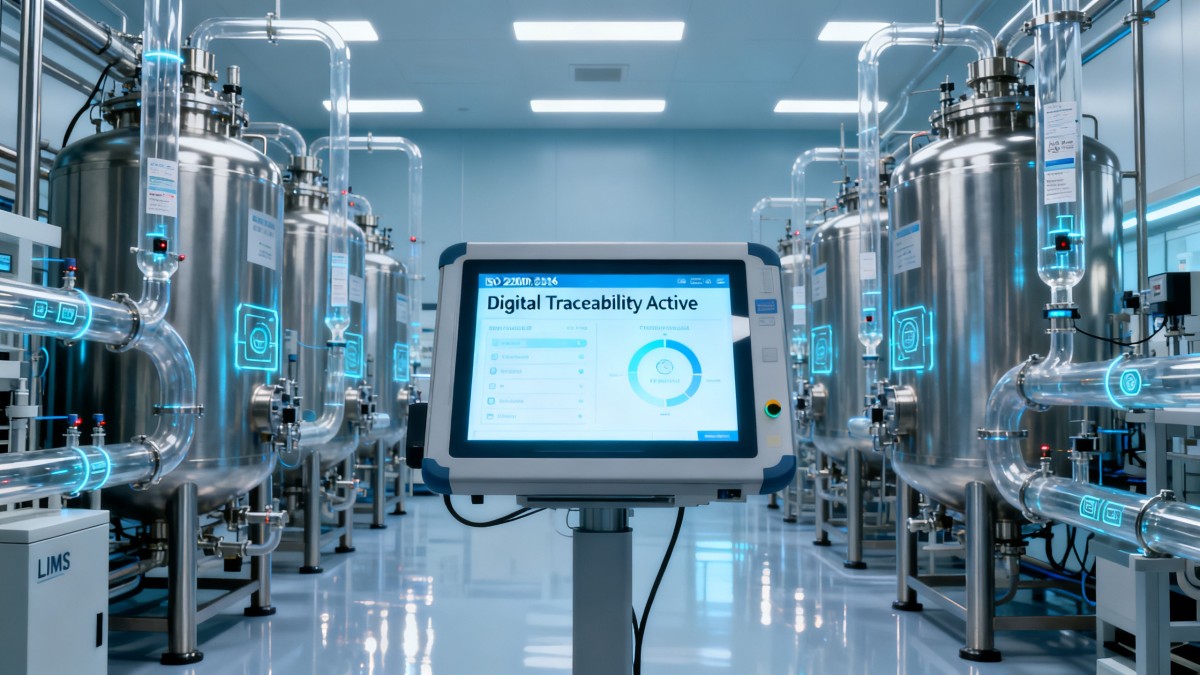
The ‘high-risk intermediate digital traceability’ clause implies granular data capture at non-final stages — including reaction conditions, reagent lot numbers, in-process analytical results, and equipment calibration logs. Firms should audit current LIMS/ELN/MES capabilities to confirm support for structured, time-stamped, and audit-trail-enabled records covering all synthetic steps.
Distinguish between certification deadline and operational implementation scope
The February 1, 2027, replacement date applies to certification status — not necessarily to every existing customer contract. However, leading EU and US procurement teams are already requesting evidence of implementation planning (e.g., gap assessments, system validation roadmaps). Early documentation of intent and progress mitigates near-term commercial risk.
Align internal quality agreements with customer-specific electronic sign-off protocols
‘Customer-customized specification electronic sign-off’ requires formalized, version-controlled, and access-logged approval workflows — distinct from email confirmations or paper-based change orders. Firms should review current specification management practices and identify where digital signature solutions (compliant with e-signature regulations such as EU eIDAS or U.S. ESIGN) must be embedded into release processes.
Editorial Perspective / Industry Observation
Observably, ISO 22000:2026 signals a structural shift: food safety management is expanding beyond end-product testing and HACCP plans into the core technical execution of chemical synthesis. Analysis shows this reflects growing regulatory convergence — particularly between food safety frameworks and pharmaceutical good manufacturing practice (GMP) expectations for complex molecules. From an industry perspective, the standard functions less as a standalone certification milestone and more as a de facto benchmark for technical credibility in regulated custom synthesis. Its enforcement will likely accelerate consolidation among smaller synthesis providers lacking scalable digital quality infrastructure.
It is important to note that while the standard is now published, its practical application remains contingent on auditor training, national accreditation body approvals, and buyer-specific interpretation of ‘high-risk intermediate’ definitions. These elements are still evolving and warrant ongoing observation.
Concluding, ISO 22000:2026 represents not merely a revision but a recalibration of quality accountability — moving upstream into synthesis design and execution. For affected enterprises, it is currently more accurate to understand this development as a binding procedural requirement in formation, rather than a fully matured operational norm. Strategic response should therefore emphasize structured readiness over rushed certification.
Source: International Organization for Standardization (ISO), official publication notice dated May 12, 2026. Note: National implementation timelines, auditor accreditation status, and sector-specific interpretations of ‘high-risk intermediate’ remain under active development and require continued monitoring.
Related Intelligence
- Custom SynthesiscGMP Chemical Synthesis Services: How to Assess API Scale-Up ReadinessCompare chemical synthesis cGMP services with confidence. Learn how to assess API scale-up readiness, process safety, quality controls, and supplier capabilities before committing.
- Custom SynthesisCustom Polymer Synthesis: What to Specify Before Requesting a QuotePlanning polymer custom synthesis? Learn what to specify—from molecular weight and purity to testing and costs—to compare quotes confidently and avoid costly surprises.
- Custom SynthesisThird-Party Testing of Chemical Synthesis Impurities: Methods and Detection LimitsExplore chemical synthesis impurities third party testing methods, detection limits, and reporting essentials to verify supplier claims and make confident sourcing decisions.
The Morning Broadsheet
Daily chemical briefings, market shifts, and peer-reviewed summaries delivered to your terminal.
