

The Authority in Global Agricultural Chemistry & Bio-Resources
How to Size Commercial Farm Feed Systems for Herd Capacity and Feed Flow
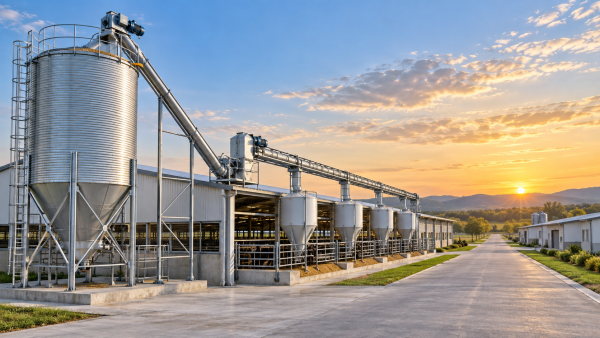
How to Size Commercial Farm Feed Systems for Herd Capacity and Feed Flow
Sizing farm commercial feed systems is not simply a matter of choosing a larger silo, wider auger, or higher-rated conveyor. It is an engineering decision that connects animal intake, ration design, delivery timing, storage resilience, labor availability, building layout, and the practical limits of site access. A system that appears adequate on a daily-feed spreadsheet can still fail during a delivery delay, a peak feeding window, a ration change, or a single-point equipment stoppage.
For project managers and engineering leads, the useful starting point is to separate three questions that are often merged too early: how much feed the operation consumes, how much feed must be stored, and how quickly feed must move through the system. Herd capacity answers only the first question. Reliable feed handling infrastructure must answer all three.
This distinction matters across dairy, poultry, swine, beef, aquaculture, and integrated feed-and-grain operations. Each has different intake patterns, feed forms, hygiene requirements, ration variability, and tolerance for interruption. The correct specification therefore begins with a flow model, not a catalogue of equipment.
Start with daily feed demand, but model the herd honestly
The basic daily demand calculation is straightforward:
Daily feed demand = number of animals × average daily feed intake per animal
The difficult part is deciding what belongs in the model. A commercial operation rarely has one uniform population. Lactating animals, dry stock, finishers, growers, breeding groups, replacement animals, and quarantine pens may consume different feed types at different rates. In poultry and swine systems, age phases can materially change the demand profile. In aquaculture, biomass and feeding intensity may shift faster than physical tank capacity suggests.
Use expected peak population rather than today’s headcount. If a site is designed for phased expansion, include the expected herd or flock at the point when the original feed system would become difficult to modify. It is usually cheaper to provide structural allowances, electrical capacity, transfer points, and space for an additional storage vessel during the first build than to retrofit them around an operating facility.
Average intake should also be treated carefully. Nutrition teams may work with dry-matter intake, while equipment suppliers commonly require tonnes, kilograms, or volume of as-fed material. Those are not interchangeable. Wet feeds, mineral supplements, mash feeds, pellets, crumbles, meals, silage ingredients, and liquid additives all behave differently in storage and transport. Before converting mass into bin capacity, confirm the actual bulk density for the material being handled. Supplier literature may provide indicative values, but the relevant figure is the feed formulation and physical condition used on the project.
Build a demand schedule instead of relying on a single daily total
A daily total is useful for procurement planning, but equipment is sized against time. If a facility consumes 30 tonnes per day, that does not mean every transfer line needs to move 1.25 tonnes per hour. Feed may need to be delivered in a short pre-feeding period, across several barns simultaneously, or in repeated batches dictated by mixers, robotic feeders, automatic pan lines, or fish-feeding controls.
Map the operating day: receiving, storage transfer, milling or mixing, feeding windows, washdown, maintenance access, and periods when noise or vehicle movements are restricted. A system that runs at its rated maximum capacity throughout its normal schedule has little room for recovery after a stoppage. The design should have usable spare capacity at the points where delays create animal-welfare, labor, or production risk.
This is especially relevant where multiple diets share common conveying equipment. One conveyor may have enough nominal throughput for total daily demand but still become a bottleneck when feed changes require cleaning, sequencing, or segregation. The more diets and destinations a facility has, the more valuable a timed flow diagram becomes.
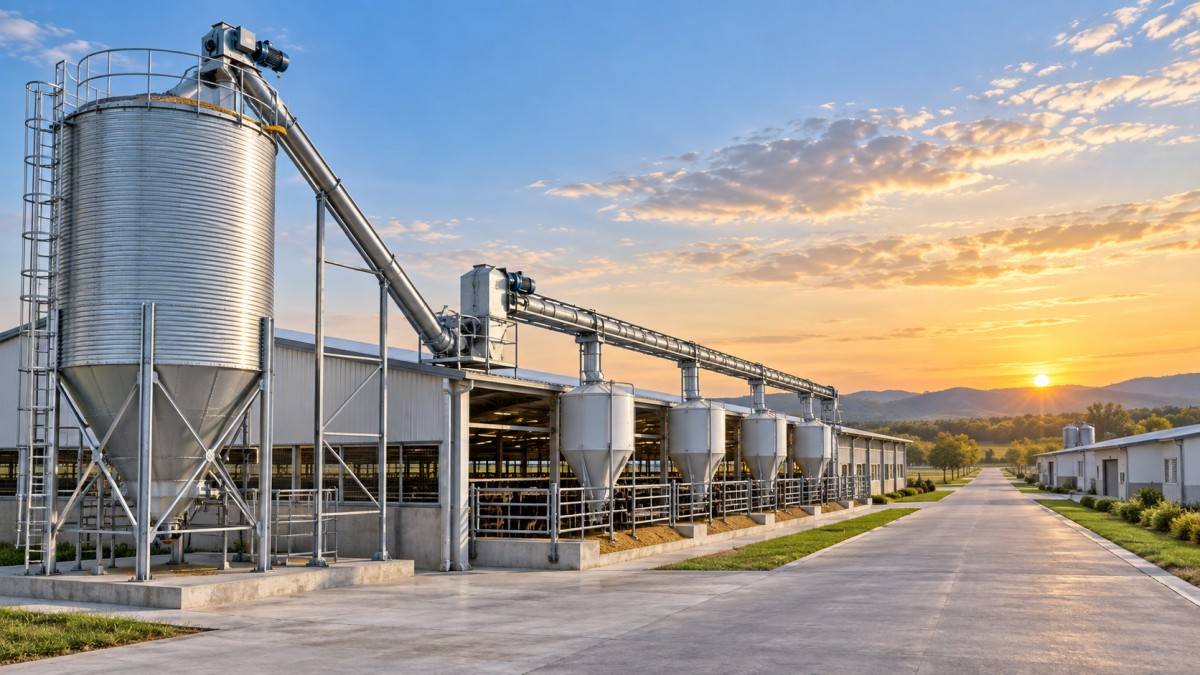
Calculate storage from logistics risk, not silo availability
Storage capacity is usually expressed as days of feed cover:
Required storage mass = expected daily demand × planned days of autonomy
Planned days of autonomy should reflect the real delivery environment. A site with dependable bulk deliveries, good road access, multiple approved suppliers, and short lead times can work with a different buffer than a remote farm exposed to weather disruption, port delays, seasonal road restrictions, or limited feed-mill capacity. The number should not be chosen because it matches a standard bin size.
A sound storage calculation also accounts for operational dead stock. Most bins cannot be treated as fully usable capacity. Material may remain below outlet geometry, bridge above discharge points, or be intentionally retained to prevent feed interruption during a delivery. High-moisture products, fine meals, sticky blends, and feeds with variable particle size may need more conservative assumptions than free-flowing pellets. Where flow aids are proposed, their suitability should be checked against the feed’s physical properties and the manufacturer’s guidance rather than assumed.
Separate storage is often justified when diets must remain distinct, when an ingredient has a different replenishment cycle, or when a single bin failure would stop the whole feeding operation. That does not always mean duplicating every component. It means identifying where a shared asset creates an unacceptable operational dependency.
Size conveyors, augers, and feeders around peak flow
Once mass and storage are understood, calculate the required feed flow rate for each transfer stage. A useful expression is:
Required flow rate = feed mass to be moved during a task ÷ available operating time
For example, the relevant task may be filling day bins before a morning feed, charging a mixer between batches, or replenishing several poultry house lines within a permitted operating window. Add time for start-up, shut-down, transitions between rations, and realistic cleaning or inspection activity. A theoretical conveying rate measured under ideal conditions is not the same as dependable system output at the installed incline, length, number of bends, moisture condition, and motor duty cycle.
Do not select equipment solely by a nameplate capacity. Ask suppliers to define the assumed material, fill ratio, conveying distance, elevation, and operating conditions behind their stated throughput. Screw conveyors, chain-and-disc systems, pneumatic transfer, belt conveyors, elevators, and flexible augers each have different strengths. The preferred method depends on feed form, route complexity, required sanitation, noise tolerance, abrasiveness, and the consequences of residual material in the line.
Long runs and multiple discharge points also raise control questions. Can the system confirm that feed reached each destination? Are level sensors positioned to prevent both overfill and run-empty events? Can an operator isolate a line without disabling unrelated barns? A basic control package may be adequate for a single straight feed route, while a multi-building site may need clearer interlocks, alarms, material tracking, and manual override procedures.
Account for the feed itself, not just the equipment
Feed handling projects often encounter problems because the equipment was specified for a generic “bulk feed” rather than the actual ration. Pellets can break down under repeated handling. Fine ingredients may generate dust and segregate. Fibrous or high-moisture materials can resist flow. Mineral premixes and certain additives may require controlled dosing, more careful containment, or a different cleaning strategy from the main ration.
Where feed contains regulated additives, veterinary products, or materials requiring traceability, the system design should support the farm’s applicable controls for segregation, records, cleaning, and access. Requirements differ by market and production type, so this is an area for confirmation against local regulations, feed-safety plans, and customer specifications. It should not be left to a late-stage mechanical substitution.
The same principle applies to dust management and worker safety. Dust-prone handling points, enclosed transfer routes, electrical classification, ventilation, housekeeping access, and emergency isolation need review as part of the engineering package. The correct approach depends on site conditions and local requirements, but ignoring these issues while concentrating only on tonnes per hour creates a narrow and incomplete design brief.
Design for failure recovery and maintainability
A feed system is only as reliable as its ability to recover from ordinary faults. Motors fail, sensors become contaminated, material bridges, delivery trucks arrive late, and operators need to clear blockages safely. For high-consequence routes, consider whether the design needs alternate feed access, a bypass route, spare drive provisions, independent bins, or a manual feeding contingency. The answer depends on herd size, feeding frequency, staffing, and how long animals can safely wait before the missed feed becomes critical.
Maintenance access deserves the same attention as rated throughput. Check whether technicians can safely reach motors, bearings, inspection covers, filters, sensors, and discharge gates without improvised work platforms. Confirm lifting arrangements for heavier components and leave room for cleaning tools, vehicle circulation, and future replacement. A compact layout can look efficient on a drawing while making routine maintenance slow and risky in operation.
Power resilience should be reviewed early. The project team needs to understand which components must remain available during an outage, whether standby generation covers them, and what restart sequence is required. In automated feeding environments, a controlled restart may matter as much as backup power itself; restarting all loads at once can create avoidable electrical or mechanical stress.
Turn the concept into a procurement-ready design brief
Before comparing proposals, issue the same technical basis to every supplier. At minimum, the brief should define present and planned animal populations; ration types and physical properties; daily and peak feed demand; desired storage autonomy; delivery method; site layout; transfer distances and elevations; feeding windows; environmental conditions; electrical supply; control expectations; maintenance constraints; and required documentation.
Ask vendors to state exclusions and assumptions clearly. A low initial price can conceal omitted foundations, unloading connections, dust controls, electrical panels, controls integration, commissioning support, or performance conditions. Equally, a proposal with a larger silo or conveyor is not automatically more resilient if it leaves a critical single point of failure elsewhere in the system.
For complex projects, the most useful comparison is not a simple equipment list. It is a line-by-line review of mass balance, storage days, peak transfer duty, route constraints, cleanout approach, alarm philosophy, and expansion path. This is where feed-and-grain processing intelligence becomes valuable: good decisions sit at the intersection of animal production requirements, mechanical design, materials behavior, and supply-chain reality.
AgriChem Chronicle follows these connections across agricultural machinery, feed processing, ingredients, and primary-industry supply chains. For engineering teams, the practical lesson is consistent: specify the feed system around verified operating conditions, not nominal capacity alone. Confirm the assumptions with nutrition, operations, logistics, and maintenance stakeholders before equipment is released for manufacture. That discipline usually reveals whether the proposed system has been sized for a farm’s real flow of feed—or only for its projected headcount.
Related Intelligence
- Feeding & Watering SystemsHow to Size Commercial Farm Feed Systems for Herd Capacity and Feed FlowFarm commercial feed systems: learn how to size storage, conveyors, and feed flow for herd capacity, peak demand, resilience, and efficient farm operations.
- Feeding & Watering SystemsSelecting a Nipple Drinking System for Broiler and Layer HousesNipple drinking system selection guide for broiler and layer houses: compare water flow, pressure control, flushing, durability, and installation needs.
- Feeding & Watering SystemsHow to Select Poultry Feeding Systems for Broiler Farms by Flock Size and Feed WasteFarm poultry feeding systems: learn how to match feeder design to broiler flock size, reduce feed waste, improve uniformity, and control lifecycle costs.
The Morning Broadsheet
Daily chemical briefings, market shifts, and peer-reviewed summaries delivered to your terminal.
