

The Authority in Global Agricultural Chemistry & Bio-Resources
How to Troubleshoot Common Feed Machinery Breakdowns
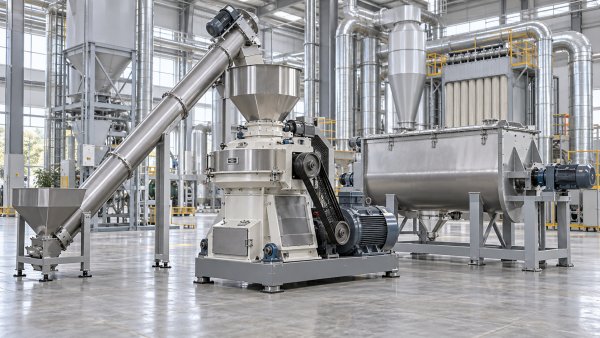
Start by Containing the Fault, Not Restarting the Line
A feed line can lose production long before it stops completely. A pellet mill may continue running with poor pellet durability, a mixer may turn while producing an uneven batch, or a conveyor may move material intermittently until a belt failure brings the process to a halt. In each case, repeated restarts can turn a manageable mechanical or process issue into damaged equipment, contaminated feed, or a longer shutdown.
For operators learning how to troubleshoot common feed machinery breakdowns, the most useful first step is to separate a safety-critical fault from a performance fault. Smoke, burning odour, abnormal vibration, exposed moving parts, electrical trips, hot bearings, or a sudden rise in motor load require an orderly shutdown and isolation before inspection. A gradual fall in throughput, inconsistent particle size, uneven mixing, or a modest increase in power draw may permit controlled diagnosis, but only if the equipment remains within its operating limits.
The same symptom can have several causes. A pellet mill blockage may originate in the die, but it may also begin upstream with excess moisture, poor grinding, an inconsistent formulation, or a feeder delivering material unevenly. Effective troubleshooting follows the material path and the power path rather than replacing the part nearest the visible problem.
Use the Production Record to Narrow the Search
Before opening guards or dismantling components, compare the present condition with the last known stable run. Operators should record the feed formula, ingredient lot changes, conditioning temperature and moisture where applicable, production rate, motor load, die or screen changes, lubrication activity, alarms, and the time at which the fault appeared. This information often distinguishes a process deviation from mechanical wear.
A failure that begins immediately after changing a ration, adding a new ingredient source, adjusting screen size, or increasing throughput should first be treated as a process compatibility question. A fault that develops progressively over several shifts is more likely to involve wear, misalignment, inadequate lubrication, contamination, or deteriorating electrical components. Sudden failure without a corresponding material or operating change deserves closer inspection for broken fasteners, foreign objects, failed bearings, overloaded drives, or electrical faults.
Do not assume that the loudest or hottest component is the original source. A conveyor motor can overheat because a bearing has seized at the tail pulley. A pellet mill drive can overload because restricted discharge is backing material into the press. A mixer gearbox can become noisy because the mixer is being overfilled or because heavy material has accumulated in an area that should be self-cleaning.
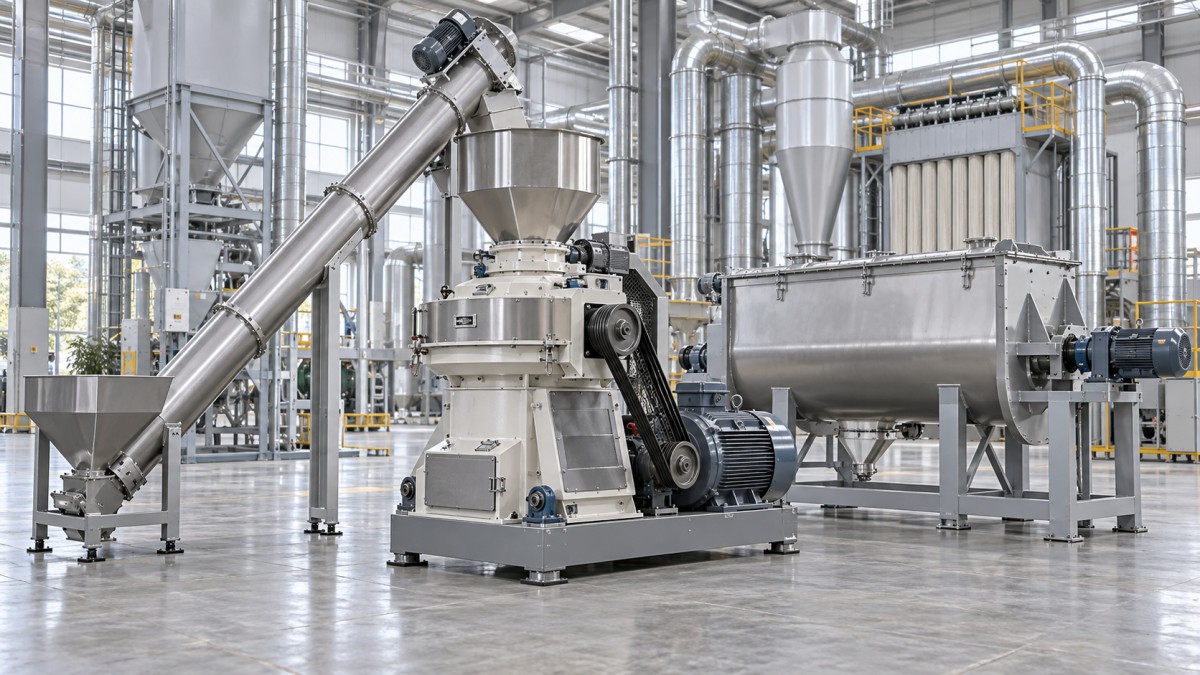
When Material Stops Moving: Check Flow Restrictions in Sequence
Material-flow faults are among the most common causes of lost output in feed processing. They may appear as bridging in bins, erratic feeder discharge, plugged conveyors, choked elevators, blocked aspiration paths, or pellet mill surging. The practical error is to clear the location where material has accumulated without identifying why it accumulated there.
Begin upstream and work downstream. Confirm that the receiving bin and hopper are discharging consistently. Inspect for bridging, rat-holing, compacted fines, wet patches, foreign material, damaged agitators, and partially closed slide gates. Check screw feeders and rotary valves for build-up, worn flights, slipping couplings, or variable speed control problems. If the feeder is unstable, downstream equipment will often appear faulty even when it is mechanically sound.
For screw conveyors, a sudden blockage can result from foreign material, a bent screw, damaged hanger bearings, excessive moisture, or a discharge restriction. A screw that turns but conveys little material may have worn flights, incorrect rotation after electrical work, excess clearance, or a partially filled inlet that causes intermittent loading. Running a plugged screw repeatedly risks twisting the shaft, damaging the gearbox, and creating a much larger repair scope.
Bucket elevators require particular caution. A belt that drifts, slips, or tracks unevenly can quickly damage the belt, buckets, casing, and pulleys. Check belt tension, pulley condition, alignment, boot clean-out, bearing temperature, and buildup around the head section. If an elevator plugs, investigate the discharge and aspiration condition as well as the boot. Material that cannot leave the head cleanly will recirculate, overload the belt, and return downward.
In pneumatic conveying and aspiration systems, reduced air movement can be mistaken for a material handling problem. Plugged filters, damaged ducting, blocked cyclones, air leaks, incorrectly positioned dampers, or a fan operating outside its intended range can cause material to settle in lines or create poor separation. Dust control is not separate from equipment reliability: poor airflow can increase contamination, reduce cooling, and destabilise material movement across the line.
Pellet Mill Problems Usually Begin Before the Die
Pellet mill blockages, poor pellet quality, high power consumption, and low output are often blamed on the die and rolls. Those parts matter, but they work at the end of a chain of conditions. Material particle size, formulation, moisture distribution, steam quality, retention time, feed rate, die condition, roll adjustment, and cooling all influence what happens at the press.
If the mill begins to surge or plug, stop forcing material through at a higher feed rate. First inspect whether conditioned mash is too wet, too dry, poorly mixed, or inconsistent in temperature. Material with uneven moisture can form compacted zones in the die while other portions pass too freely. Coarse or variable particle size can also make conditioning and compression less predictable. A recent ingredient substitution may alter fat, fibre, starch, or natural moisture characteristics enough to change pelleting behaviour even if the formula appears similar on paper.
Where throughput has fallen gradually, inspect the die for worn or blocked holes, glazing, corrosion, poor cleaning practices, and incorrect storage. Die holes can become restricted by oxidised material or residual product after idle periods. Roll shells should be checked for wear and proper adjustment, while bearings and drive components should be evaluated for heat and abnormal noise. A worn roll shell may reduce traction and increase slippage; tightening the rolls aggressively can accelerate damage rather than restore output.
Pellet quality provides diagnostic evidence. Excess fines after cooling can indicate weak conditioning, unsuitable formulation behaviour, worn die or rolls, excessive handling, or inadequate cooling. Soft or deformed pellets may point to high discharge moisture, insufficient cooling air, overloaded coolers, or material that did not set properly through the die. An overfilled cooler can create its own downstream quality issue by retaining heat and moisture beyond the expected cooling stage.
It is useful to distinguish between a die that is genuinely worn and one that is operating under unsuitable process conditions. Replacing the die may produce a short-lived improvement while leaving the underlying cause intact. Before ordering major pellet mill components, review feed rate, conditioning consistency, motor load history, lubricant condition, and the physical state of the product entering and leaving the mill.
Uneven Mixing Is a Quality Fault, Even When the Mixer Runs Normally
A mixer can appear mechanically healthy while producing inconsistent feed. This is especially risky where minor ingredients, medications, supplements, or trace components depend on uniform distribution. Visual inspection alone is not a reliable indicator of mix quality, particularly in large batches or formulations with different particle sizes and bulk densities.
When a formulation shows inconsistency, verify the batch sequence before changing mixer settings. Incorrect ingredient addition order, short mixing time, excessive batch size, poor micro-ingredient dosing, and delayed liquid addition can all create uneven distribution. Fine materials may adhere to surfaces or form agglomerates; liquids can create wet zones if nozzles are blocked, pressure is unstable, or spray coverage is poor.
Mechanical inspection should include paddle or ribbon condition, shaft bearings, seal integrity, gearbox noise, discharge gate closure, and internal buildup. Worn mixing elements reduce movement through the batch, while a leaking or poorly sealed discharge gate may allow material to leave before the mixing cycle is complete. Material residue trapped in corners, around seals, or under damaged liners can also carry over into later batches.
Increasing mixing time is not always the right correction. Overmixing may cause segregation in some formulations, particularly where particles differ significantly in size or density. The better response is to confirm the intended batch size, sequence, fill level, and mixing time for the formulation being produced, then assess performance through a suitable internal quality-control method rather than relying on assumptions.
Motor Heat, Trips, and Vibration Need Different Diagnostic Paths
Electrical and drive faults deserve disciplined investigation because they can be symptoms of both electrical defects and mechanical overload. A motor that trips occasionally may have an overloaded process, poor ventilation, failing bearings, voltage imbalance, loose terminals, incorrect protection settings, or a problem in the starter or variable-frequency drive. Resetting the protection device without identifying the cause removes an important warning signal.
Temperature and vibration trends are more useful than a single observation. A bearing housing that has become progressively hotter, a gearbox that has developed a new tonal noise, or a motor whose operating current is rising at the same production rate should be inspected before failure occurs. Maintenance teams should compare readings against the equipment's established normal condition and manufacturer limits, rather than relying only on whether a surface feels hot by hand.
Alignment matters across belts, chains, couplings, and gear drives. Misalignment increases friction and bearing load, but it can also produce symptoms elsewhere in the system. A conveyor belt may wander because a pulley is misaligned, because the frame has shifted, because material is loading off-centre, or because buildup is changing the pulley surface. Replacing the belt without correcting tracking conditions typically leads to a repeat failure.
Build Prevention Around Recurring Failure Patterns
The most effective maintenance programme is built from the faults that interrupt a specific plant, not from an overly broad checklist. Every significant stoppage should leave behind a short record: symptom, equipment state, material being processed, confirmed cause, corrective action, parts used, and whether the problem returned. Over time, this identifies whether the plant is dealing with random component failures, recurring formulation-related issues, inadequate operating procedures, or a design limitation at a particular transfer point.
Daily operator checks should focus on changes that can be seen or heard early: leaks, belt tracking, unusual noise, dust escape, product buildup, bearing temperature changes, inconsistent discharge, and guard condition. Scheduled maintenance should then address lubrication, fastener torque, wear surfaces, drive alignment, electrical connections, calibration of dosing equipment, and cleaning of areas where product can accumulate.
Spare-parts strategy also affects recovery time. Keeping every component in stock is rarely practical, but critical-path items deserve different treatment from ordinary consumables. A site should know which bearings, belts, sensors, seals, gearbox components, dies, roll shells, and electrical items could stop production or create a feed-quality risk. For those items, lead time, interchangeability, storage condition, and installation requirements matter as much as purchase price.
Feed machinery breakdowns are rarely solved well by treating each alarm as an isolated event. Trace the fault through material condition, machine condition, controls, and operating changes. That approach reduces unnecessary part replacement, protects feed quality, and gives maintenance and production teams a clearer basis for deciding when to restart, when to repair, and when the process itself needs correction.
Related Intelligence
- Commercial Feed PelletHow to Troubleshoot Common Feed Machinery BreakdownsHow to troubleshoot common feed machinery breakdowns with practical checks for blockages, pellet mills, mixers, motors, and preventive maintenance.
- Commercial Feed PelletHow Can Feed Pellet Quality Be Kept Consistent Across Batches?Learn how to ensure feed pellet quality consistency across batches with proven controls for ingredients, conditioning, milling, cooling, testing, and traceable process data.
- Commercial Feed PelletHow feed pellet machine wear rates vary with soybean meal inclusion and die temperatureFeed pellet machine die wear spikes with soybean meal—discover how real-time die temperature control cuts wear by up to 40%. Optimize now.
The Morning Broadsheet
Daily chemical briefings, market shifts, and peer-reviewed summaries delivered to your terminal.
