

The Authority in Global Agricultural Chemistry & Bio-Resources
Parboiled Rice Mill Plant Process Explained: Main Machines, Flow, and Output Planning
Why a parboiled rice mill plant needs process-first planning
Planning a parboiled rice mill plant is not just about buying machines and setting them in a line. The real work starts with flow balance, utility support, grain behavior, and output targets.
That is why early technical planning matters. When soaking, steaming, drying, husking, whitening, grading, and packing are matched correctly, the plant runs smoothly and delivers stable quality.
For sectors tracked by AgriChem Chronicle, this matters because feed and grain processing now sits inside a wider compliance and supply-chain environment. Traceability, energy use, and machine reliability all influence plant viability.
The practical goal is simple: build a parboiled rice mill plant that protects kernel quality, avoids idle machines, and produces predictable output with acceptable operating cost.
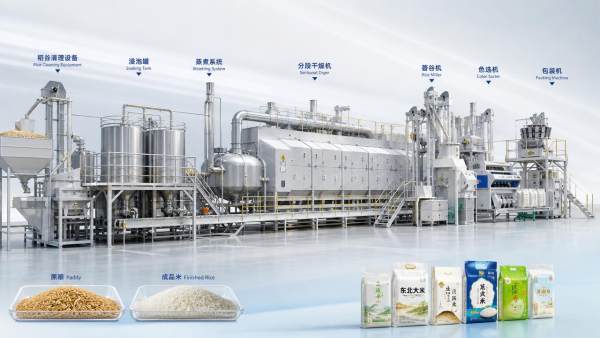
[Image 01: Process flow diagram of a parboiled rice mill plant from paddy intake to packing]
Main machines that define plant performance
A strong layout usually starts with the machines that control moisture, heat transfer, separation efficiency, and broken rice rate. If one of these is undersized, the whole parboiled rice mill plant feels unstable.
- A paddy cleaner removes stones, dust, straw, and metal before soaking. Clean incoming grain protects downstream equipment and reduces uneven steaming, blockages, and unexpected maintenance stops.
- Soaking tanks must hold enough grain for batch continuity. Good tank sizing supports controlled moisture absorption, steadier gelatinization, and fewer quality swings between production cycles.
- A boiler and steaming vessel shape the parboiling result. Stable steam pressure improves starch transformation, kernel hardness, and milling recovery inside the parboiled rice mill plant.
- Dryers are often the true bottleneck. They must remove moisture gradually, because aggressive drying increases fissures, raises broken grain, and reduces final marketable rice output.
- Rubber roll huskers, paddy separators, and whiteners should be capacity-matched. If not, recycled material grows fast and the process line starts losing efficiency hour by hour.
- Graders, color sorters, and packing machines convert milling output into sellable lots. These machines support quality consistency, branding, and dispatch readiness without slowing core production.
Utility systems are part of the machine package
Many project delays happen because utilities are treated as secondary. In reality, boiler feed water, condensate recovery, electrical load, compressed air, and ventilation affect daily performance as much as the main line.
In a parboiled rice mill plant, utility instability shows up quickly. Dryers lose control, sorters misread kernels, conveyors stop unevenly, and moisture variation increases before operators can correct it.
The process flow that should stay balanced
A practical flow usually moves through pre-cleaning, soaking, steaming, drying, tempering, husking, separation, whitening, grading, sorting, and packing. The sequence sounds straightforward, but balance between stages is the real challenge.
- Pre-cleaning should happen before any wet treatment. Cleaner paddy improves soaking uniformity and lowers contamination risk in tanks, pipelines, elevators, and thermal processing sections.
- Soaking time must fit paddy variety, initial moisture, and target finish. Short soaking leaves hard centers, while long soaking increases odor risk and handling complexity.
- Steaming should be measured, not guessed. Consistent residence time and pressure help the parboiled rice mill plant achieve better grain strength and more stable color.
- Drying usually works best in stages with tempering between passes. This reduces internal stress and helps kernels survive husking and whitening with fewer breaks.
- After drying, paddy should rest before milling. Tempering equalizes moisture and supports smoother husking, cleaner bran separation, and improved downstream grading results.
- Final grading and sorting should match market specification. This protects product value and avoids rework, especially when buyers require tighter broken and color limits.
A common field scenario
One frequent situation is a well-funded installation with large soaking tanks and a strong boiler, but limited dryer capacity. On paper, the plant looks productive. In operation, wet paddy starts queueing.
That queue becomes expensive fast. Delayed drying changes moisture behavior, creates uneven batches, and pushes the parboiled rice mill plant into stop-start production. Capacity planning should always begin with the slowest stage.
Output planning: what capacity figures should really mean
Nameplate capacity alone is not enough. A plant rated at a certain tons-per-day figure may never reach it if soaking cycle time, dryer retention time, or separator recycle load is ignored.
Useful output planning for a parboiled rice mill plant should include paddy intake, parboiling batch duration, drying throughput, head rice recovery, broken percentage, and packing shift efficiency.
Another realistic operating condition
In regions with mixed paddy supply, raw grain quality may shift week to week. A fixed process setting rarely works well across all lots, especially for soaking duration and final dryer discharge moisture.
That is why output planning should include a working range, not one perfect number. A resilient parboiled rice mill plant is designed to absorb raw material variation without major yield loss.
Details that are often missed during project execution
Small omissions can become expensive once installation starts. The most common problems are not dramatic design errors. They are usually coordination gaps between process, civil, electrical, and operations teams.
- Floor height and equipment access need review early. Poor access makes roll changes, bearing service, and screen cleaning slower across the entire parboiled rice mill plant.
- Steam line insulation should not be treated as optional. Heat loss hurts process consistency, wastes fuel, and makes temperature control harder during long shifts.
- Dust collection around milling and grading sections improves safety and cleanliness. It also protects sensors, motors, and sorting accuracy in daily production.
- Drainage near soaking and steaming zones needs careful slope design. Standing water increases sanitation risk and complicates movement, cleaning, and maintenance routines.
- Spare parts planning should cover wear items from day one. Waiting for husker rolls or sorter components can stop output longer than expected.
- Instrumentation must support operators with real numbers. Moisture meters, temperature points, and steam pressure readings reduce guesswork and improve repeatable performance.
Compliance and documentation matter too
ACC’s industry coverage repeatedly shows that technical credibility now depends on documentation as much as machinery. Equipment specifications, process records, utility data, and maintenance logs strengthen traceability and operational trust.
For a parboiled rice mill plant, that means keeping line diagrams, batch records, moisture reports, and inspection routines aligned. Good records make troubleshooting faster and expansion planning more accurate.
Practical decisions before finalizing the layout
Before freezing the layout, it helps to test the design against daily operating questions. This prevents attractive drawings from becoming difficult plants once real paddy, steam, dust, and labor enter the system.
- Map every material path from intake to dispatch. If operators need repeated cross-movement, the layout likely adds avoidable delay and higher handling cost.
- Confirm whether production will run by batch, semi-continuous, or continuous logic. The answer changes tank sizing, buffer storage, and shift scheduling assumptions.
- Check whether the boiler room, dryer section, and milling floor can expand later. Future flexibility lowers reinvestment pressure when demand grows.
- Run a utility balance before procurement closes. Water, fuel, power, and air shortages can limit a parboiled rice mill plant more than machine size.
- Set quality targets in measurable terms. Broken percentage, whiteness, moisture, and color limits should guide machine selection and commissioning priorities.
- Plan operator training around process control points, not only startup steps. Better response at soaking, steaming, and drying stages protects long-term plant performance.
Closing view on building a reliable parboiled rice mill plant
A reliable parboiled rice mill plant is built on balanced flow, not isolated equipment decisions. The strongest projects usually give equal attention to machines, utilities, grain variability, documentation, and maintainability.
If the next step is layout review or equipment comparison, start with the bottleneck stage, then verify how every upstream and downstream section supports it. That approach gives a clearer basis for capacity, cost, and output planning.
With that structure in place, a parboiled rice mill plant becomes easier to commission, easier to stabilize, and far more likely to deliver the output expected on paper.
Related Intelligence
- Milling MachineryChanging Hammer Mill Screens: Particle Size Control and DowntimeIs it easy to change the screen or adjust the output size of the hammer mill? Discover practical tips for smoother screen changes, consistent particle size, and less downtime.
- Milling MachineryChanging Hammer Mill Screens: Particle Size Control and DowntimeIs it easy to change the screen or adjust the output size of the hammer mill? Discover practical tips for smoother screen changes, consistent particle size, and less downtime.
- Milling MachineryHow Should Milling Machinery Be Maintained to Extend Its Service Life?Learn how to maintain processing machinery to extend service life with practical milling maintenance tips on cleaning, lubrication, and wear checks to reduce downtime.
The Morning Broadsheet
Daily chemical briefings, market shifts, and peer-reviewed summaries delivered to your terminal.
