

The Authority in Global Agricultural Chemistry & Bio-Resources
CoBank: Aging, Shrinking US Barge Fleet Threatens Grain Exports

A CoBank report warns that an aging and shrinking US inland barge fleet could create capacity constraints for grain exports as demand for transport grows. The date of the report was not specified in the information provided. Although no new policy, regulation or trade rule is identified, the projected capacity gap is relevant to how exporters, buyers, transport providers and farmers plan shipments and assess costs over the coming decade.
Fleet and export forecasts point in different directions
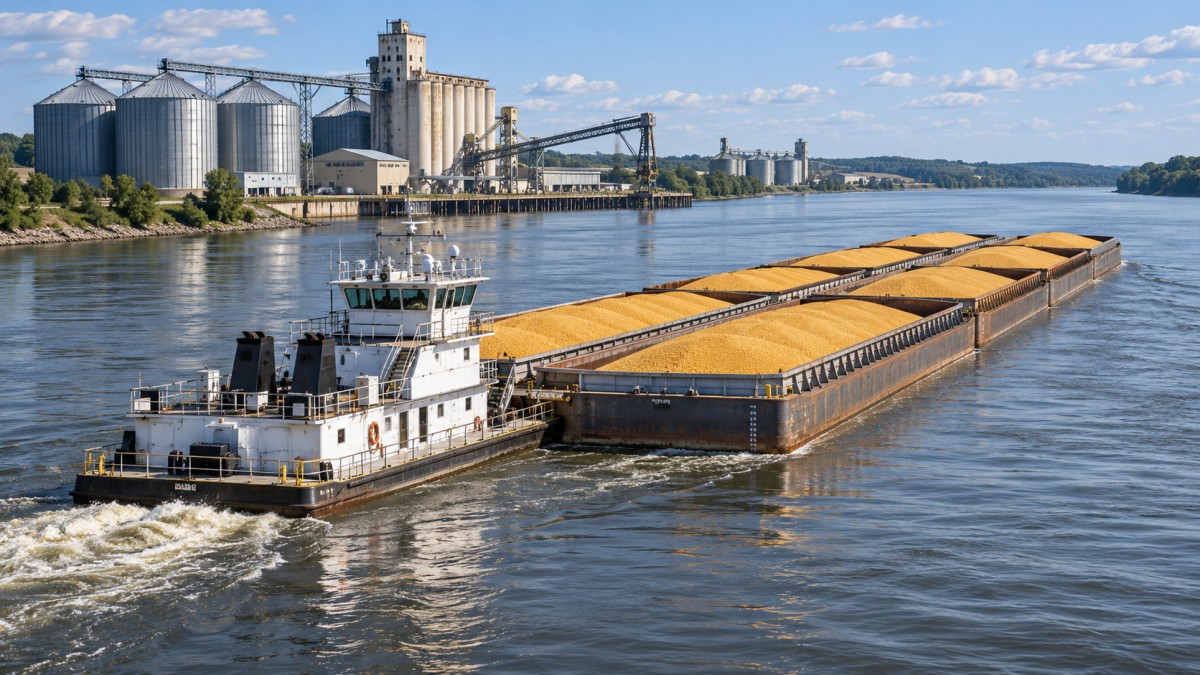
CoBank reports that the US inland barge fleet is aging and shrinking. It projects that the fleet will be approximately 17% smaller by 2035. At the same time, the US Department of Agriculture (USDA) forecasts a 9% increase in grain and oilseed exports.
The report warns that tighter barge availability could push up transportation rates and weaken the grain basis paid to farmers. It also identifies a significant risk of logistics bottlenecks and cost pressure for US grain exports over the next decade.
Where a tighter fleet could affect the grain trade
Exporters may face less certainty when booking transport
From an industry perspective, exporters are exposed to the gap between the projected reduction in fleet size and the forecast increase in exports. If available capacity tightens, securing barge space at an acceptable rate could become more difficult. The effect on an individual exporter would depend on the transport capacity available for its shipments and the terms it negotiates.
Analysis suggests that the issue extends beyond the quoted freight rate. An exporter that cannot obtain capacity when needed may have to reconsider shipment timing, the volume it commits to deliver or the margin it expects from a transaction. A higher transport cost could also change the price at which a sale remains commercially viable. None of these outcomes is established for a particular company by the information provided.
Existing sales and transport agreements may therefore deserve closer review, especially where a delivery commitment is firm but the corresponding freight cost or capacity has yet to be secured. This is a commercial planning issue arising from the report's warning; the supplied information does not identify a new export rule or a change to required trade documentation.
Farmers could see pressure on the price received
CoBank specifically warns that tighter barge availability could weaken the grain basis paid to farmers. In practical terms, the concern is that rising transport costs may be reflected in the relationship between the price received by a farmer and the relevant reference price. The report's warning does not establish that this adjustment has already occurred or that every farmer would experience the same effect.
Analysis suggests that farmers and their commercial counterparties may need to pay closer attention to how freight expectations are reflected in purchase offers. A change in the basis could affect the value of a sale even when a reference price moves independently. The timing and size of any effect remain uncertain in the absence of more detailed evidence.
Buyers and logistics providers may need to revisit commitments
For buyers of US grain and oilseeds, the possible consequences are not limited to the price of the product. If freight availability tightens, delivery schedules and the allocation of transport costs could become more important in negotiations. Buyers may wish to understand which party is responsible for arranging inland transport and how a delay or cost increase would be handled under the relevant agreement.
For barge and other logistics providers, the forecast raises questions about capacity planning and the reliability of commitments offered to customers. Analysis suggests that providers may face harder choices when matching available equipment to requests if demand grows while the fleet contracts. The input does not establish how individual providers will respond, whether replacement capacity will become available or whether any particular route will face a shortage.
Planning for freight costs and delivery uncertainty
Compare shipment needs with available capacity
Exporters and their logistics partners can use the report as a prompt to examine how much transport capacity their expected shipment plans would require. A useful assessment would distinguish volumes already covered by transport arrangements from volumes for which capacity and rates remain open. It could also identify periods in which several commitments depend on the same available capacity.
Such a review would not establish that a shortage will occur. Its value is to make potential exposure visible while the forecast remains uncertain. Companies could update the assessment as they receive more reliable information on fleet availability, export demand and the terms offered by transport providers.
Test the effect of higher rates on transaction economics
Analysis suggests that exporters, buyers and grain purchasers could evaluate how different freight cost assumptions affect their expected margins and purchase prices. The exercise is relevant because CoBank identifies higher transport rates and a weaker basis for farmers as possible consequences of tighter barge availability.
Any scenario should be treated as a planning assumption rather than a prediction of a particular rate. Companies may also want to clarify which costs are included in quoted prices and which party bears a later increase. The input provides no basis for assigning a specific increase or calculating its effect on a particular transaction.
Review delivery terms before making firm commitments
Businesses may wish to check whether their sales and transport arrangements align on shipment timing, capacity and responsibility for delays. If an export agreement promises a delivery schedule while transport remains unconfirmed, the business could face an avoidable mismatch between its commercial commitment and the service it has arranged.
Where appropriate, counterparties can discuss how they would respond to a change in freight availability or cost. These discussions are voluntary commercial measures, not requirements introduced by the CoBank report. The information provided does not specify contract terms, new documentation or a mandated procedure.
Assess alternatives against actual shipment needs
If a business identifies a potential capacity gap, it may consider whether an alternative transport arrangement or a revised shipment schedule could meet its obligations. Analysis suggests that any option should be assessed for availability, cost and its effect on the agreed delivery timetable before it is relied upon.
The supplied information does not identify a specific substitute route, transport mode or provider, and it does not establish that an alternative would be cheaper or readily available. The practical step is to verify a proposed option with the relevant counterparties and incorporate any confirmed constraints into planning.
What the forecasts do—and do not—signal
At this stage, it is more appropriate to understand the report as a warning about future logistics capacity than as an announced rule change or an implementation signal from a regulator. CoBank's projected fleet reduction and USDA's export forecast describe potential developments; they do not, on their own, establish what freight rates, shipment delays or farm prices will be.
The two percentages also measure different things: one concerns the size of the barge fleet by 2035, while the other concerns forecast grain and oilseed export growth. They should not be combined as if they were directly comparable measures of available transport capacity and transport demand. The information supplied does not provide the detail needed to calculate a capacity shortfall.
What deserves closer attention is whether later evidence shows that transport availability is tightening, how freight prices respond and whether changes appear in the basis paid to farmers. Updated export forecasts and information on the condition and size of the fleet could also affect the assessment. Those developments would help businesses distinguish a forecast risk from a constraint that is becoming visible in actual transactions.
From a trade execution perspective, the report may encourage closer scrutiny of delivery commitments and freight arrangements. It does not establish a new certification, compliance obligation or trade restriction. If authorities or market participants subsequently publish relevant changes, companies would need to assess those developments on their own terms.
A capacity warning for longer-term trade planning
The report places a possible contraction in the US inland barge fleet alongside a forecast increase in grain and oilseed exports. Its central commercial concern is that less available barge capacity could raise freight costs, weaken the basis paid to farmers and make export logistics harder to manage.
The measured response is to treat those outcomes as risks to evaluate, not as results already observed. Businesses can review capacity, pricing and delivery assumptions while continuing to check whether later evidence supports or changes the outlook.
What the supplied information can support
This article is based on the user-provided news title, event timing and event summary. The supplied information did not specify when the report was published or provide a specific official source link; those details and the underlying forecasts should be verified as further information becomes available.
Follow-up material could include the CoBank report, USDA publications, relevant official releases and industry reporting. Continued attention to actual trade execution, freight availability, pricing and feedback from affected businesses would help assess whether the projected pressures are emerging and whether any subsequent policy or trade measures become relevant.
Related Intelligence
- Grain Silos & StorageGrain Silo Comparison: Steel vs. Concrete for Long-Term StorageGrain silo comparison: Explore steel vs. concrete for long-term storage, from durability and moisture control to lifecycle costs and expansion.
- Grain Silos & StorageGrain Conveyor Compliance: OSHA Requirements for Grain Handling FacilitiesGrain conveyor compliance starts with safer operations. Explore OSHA requirements for guarding, lockout, dust control and maintenance in grain handling facilities.
- Grain Silos & StorageCoBank: Aging, Shrinking US Barge Fleet Threatens Grain ExportsUS barge fleet decline could threaten grain exports. Explore CoBank’s warning and what tighter freight capacity may mean for costs and farmers.
The Morning Broadsheet
Daily chemical briefings, market shifts, and peer-reviewed summaries delivered to your terminal.