

The Authority in Global Agricultural Chemistry & Bio-Resources
Grain Silo Comparison: Steel vs. Concrete for Long-Term Storage
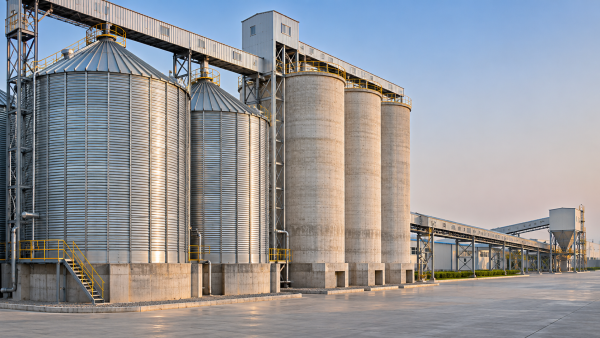
Steel and concrete can both support long-term grain storage, but neither material protects grain quality on its own. Steel often offers a lighter structure and a more flexible route to phased capacity, while concrete can be attractive for permanent, high-throughput facilities where structural integration and thermal mass justify the construction commitment. The better choice depends on the complete storage system: foundations, wall loads, aeration, moisture exclusion, discharge equipment and inspection access.
The most consequential distinction is not simply how long the shell lasts. It is whether the structure can remain dry, be emptied reliably, accommodate the intended grain flow and be maintained without unacceptable disruption throughout its service life. A credible grain silo comparison therefore needs a common operating basis, not just a price per tonne of nominal capacity.
Start with the grain and the operating cycle
Storage duration, commodity characteristics and turnover rate determine which design features matter most. A silo holding dry wheat through seasonal price cycles has a different risk profile from a facility receiving variable-moisture maize during a concentrated harvest and discharging it continuously to a feed mill.
Define the maximum quantity to be stored, expected fill and discharge rates, grain bulk density, moisture at intake and the number of annual turnovers. Also distinguish between total geometric capacity and usable capacity. Cone-shaped grain surfaces, discharge limitations, aeration-floor arrangements and operating allowances can reduce the quantity that can be stored or recovered under normal conditions.
Grain is not a simple liquid load. Pressure on silo walls depends on the stored material, wall friction, geometry and how the silo is filled and emptied. Eccentric discharge, uneven filling or a blocked outlet can produce load patterns that differ from those assumed for a uniform flow. Steel and concrete silos both require a structural design based on the intended commodities and operating arrangements; substituting a different grain or modifying an outlet can invalidate original assumptions.
For long-term storage, specify the handling system alongside the shell. A well-designed structure can still lose product through inadequate drying, poor airflow distribution, leaks or inaccessible residues. Conversely, a robust monitoring and aeration system cannot compensate for a silo that was not engineered for its actual loading and discharge conditions.
Structural durability: different deterioration mechanisms
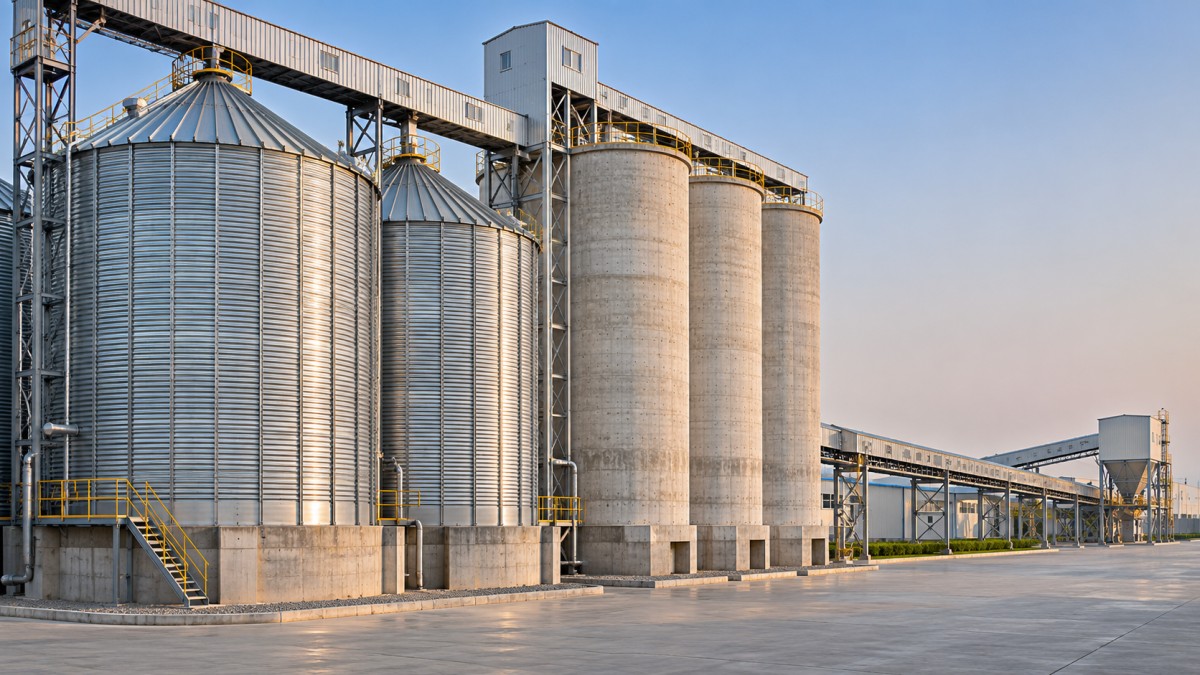
Steel silos are commonly assembled from bolted, coated sheets or fabricated steel sections. Their relatively low structural weight can simplify transport and erection, but the design must account for wind uplift, buckling, seismic actions where applicable, and local stresses around doors, supports and conveyor attachments. A lighter superstructure does not eliminate the need for substantial foundations: grain loads and site soil conditions remain decisive.
Corrosion protection is a central lifecycle issue. Galvanized or otherwise protected steel can perform well when the coating, fasteners, edges and joints remain in suitable condition. Persistent condensation, trapped grain residues, aggressive industrial atmospheres and exposure to fertilizer or salt can increase corrosion risk. Inspection should include roof penetrations, eaves, lap joints, stiffener connections and the base, where moisture and debris can accumulate. Repair scope depends on whether deterioration is superficial or has reduced the load-carrying section.
Reinforced concrete silos depend on concrete quality, reinforcement detailing, crack control and protection against water ingress. Concrete does not rust, but its embedded reinforcement can corrode when moisture and corrosive agents reach it. Cracking, spalling, damaged joints and leakage around roof or wall penetrations require investigation rather than cosmetic sealing alone. A repair must address the cause and, where reinforcement or structural capacity is affected, be assessed by a qualified structural engineer.
Concrete’s greater mass makes foundation design especially important. Bearing capacity, settlement and differential movement should be evaluated against the full loaded structure. Poor ground can materially change the cost and feasibility of either option; a comparison based only on above-ground construction can therefore be misleading.
Temperature and moisture control matter more than wall material alone
Concrete has greater thermal mass than thin steel sheet, so its wall temperature generally responds more slowly to changes in outdoor conditions. This can moderate short-term temperature swings at the wall. It does not, however, guarantee stable grain temperature or eliminate condensation. The stored grain itself has substantial thermal inertia, and temperature gradients can develop within a grain mass over time.
Steel walls and roofs can change temperature more quickly with weather and sunlight. Depending on the climate and conditions inside the silo, cool surfaces can encourage condensation. Concrete surfaces can also become condensation sites. In both cases, the critical question is whether water can reach grain and whether monitoring will reveal a developing problem before spoilage spreads.
Keep three moisture pathways separate when assessing a design:
- Incoming grain moisture: Drying and intake controls must bring grain within a condition suitable for its intended storage period. Aeration should not be assumed to substitute for a properly designed drying process.
- Water entry: Roof sheets, joints, hatches, vents, cable penetrations and wall-to-foundation interfaces need weather-resistant detailing and an inspection plan.
- Moisture migration and condensation: Temperature differences can drive air movement within stored grain. Temperature monitoring, appropriate aeration control and sampling help identify and manage the resulting risk.
Aeration performance depends on fan capacity against the actual system resistance, airflow distribution through the grain depth, duct layout and local ambient conditions. The selection should be checked at the intended fill level and for the grain with the highest expected airflow resistance. Temperature cables, headspace monitoring and sampling points provide information only where they are positioned and accessible; they do not directly measure every part of the grain mass.
For facilities relying on controlled-atmosphere storage or fumigation, airtightness must be specified and tested for the intended method. Neither a bolted steel silo nor a concrete silo should be assumed to be sufficiently gas-tight without appropriate design, sealing and verification. The chosen treatment also has to comply with applicable local requirements and the product label.
Discharge design can determine usable life
Long-term value depends on how consistently grain leaves the silo as well as how much enters it. Funnel flow can leave grain stationary near the walls while material above the outlet moves first. That residual grain may remain in storage through several cycles, increasing quality and cleaning concerns. Mass flow, in which the entire contents move during discharge, can reduce stagnant zones, but it requires a suitable hopper geometry, wall surface and outlet sized for the stored material.
Steel construction can accommodate a range of hopper arrangements, including elevated bins, subject to structural and foundation design. Large flat-bottom steel silos may use underfloor conveyors and sweep systems to recover grain after gravity discharge. Concrete facilities can also use hoppers, tunnels and mechanical reclaim systems; their integration into a permanent structure requires particular attention because later changes can be intrusive.
Do not assume that a steep-looking hopper will discharge every commodity without bridging or ratholing. Grain condition, fines, consolidation time and wall friction affect flow. Design checks should reflect the least free-flowing material expected, including reasonable variation in moisture and fines. Where segregation matters, consider how filling methods distribute coarse and fine particles and how discharge draws them back into the process.
Cleaning and inspection access belong in the original layout. Residue traps at ledges, transitions and reclaim equipment can complicate commodity changes and sanitation. Access must also support safe isolation, atmospheric assessment and rescue arrangements; grain engulfment and hazardous atmospheres make silo entry a serious confined-space hazard regardless of construction material.
Construction schedule and future changes
Steel silo components can be fabricated before arrival and assembled on prepared foundations, which can shorten on-site erection under suitable conditions. The actual schedule still depends on foundation curing, component delivery, weather, lifting equipment and the installation of conveyors, aeration and controls. A damaged or missing component can affect the critical path even when the shell itself is straightforward to assemble.
Concrete construction is more dependent on site work, formwork, reinforcement placement, concrete supply and curing. Construction methods and project scale affect the schedule, so a concrete option should not be rejected solely on an assumed build time. Its value can be stronger where several cells, galleries, tunnels and process buildings are planned as a long-term integrated facility.
Phased expansion is often easier to plan with separate steel bins, provided space, foundations, utility capacity and conveying routes are reserved. Concrete facilities can also be expanded, but interfaces with existing cells and shared handling structures require careful engineering. Neither material makes relocation or modification automatically simple: moving a steel silo requires assessment of its condition, connections, foundation and compliance at the new site.
Compare lifecycle cost on equivalent scope
An initial quotation for the silo shell is not a complete investment comparison. Establish the same usable storage capacity, design life, commodity, throughput and site conditions for each proposal. Then include the work needed to deliver that capacity safely and reliably:
- Ground investigation, earthworks, foundations and drainage.
- Shell, roof, structural supports and protection against corrosion or water ingress.
- Receiving, conveying, aeration, temperature monitoring, discharge and dust-control equipment.
- Installation, commissioning, access systems and required safety provisions.
- Planned inspections, maintenance, likely component replacement and associated downtime.
Use discounted lifecycle costing where the evaluation period is long enough for maintenance and replacement timing to affect the decision. A practical model adds the present value of capital expenditure, energy, inspection, repair and downtime, then subtracts any defensible residual value. Grain losses can be included when scenarios are supported by the operating assumptions, but they should not be attributed to shell material without evidence that the competing designs provide different levels of control.
Run sensitivity checks on the variables most likely to change the outcome: ground improvement, corrosion exposure, energy use, major repairs and the cost of taking capacity out of service. Avoid assigning a single guaranteed service life to either material. Durability depends on design, environment, workmanship, loading history and the effectiveness of maintenance.
When each option earns its place
Steel is a strong candidate where capacity must be delivered in stages, the site can accommodate separate bins and future expansion needs to remain flexible. It also deserves close consideration when a lighter superstructure helps address transport or site constraints. The decision becomes less straightforward where aggressive exposure, difficult inspection access or disruption from future coating and component repairs materially increases lifecycle cost.
Concrete is a strong candidate for a permanent installation with substantial integrated handling infrastructure, provided ground conditions support the heavier structure and the project can accommodate the construction method. Its thermal mass and robust enclosure are useful characteristics, not substitutes for aeration, leak prevention or condition monitoring. The evaluation should account for the difficulty and cost of investigating cracks, repairing embedded reinforcement or changing structural openings after commissioning.
The final selection should rest on a documented design basis and proposals that identify the assumptions behind structural loads, grain flow, airflow, maintenance and foundations. Where bids differ, resolve the difference before comparing totals: a lower price may reflect a genuinely efficient design, or it may reflect omitted equipment, a shorter design basis or less demanding operating assumptions.
Related Intelligence
- Grain Silos & StorageGrain Silo Comparison: Steel vs. Concrete for Long-Term StorageGrain silo comparison: Explore steel vs. concrete for long-term storage, from durability and moisture control to lifecycle costs and expansion.
- Grain Silos & StorageGrain Conveyor Compliance: OSHA Requirements for Grain Handling FacilitiesGrain conveyor compliance starts with safer operations. Explore OSHA requirements for guarding, lockout, dust control and maintenance in grain handling facilities.
- Grain Silos & StorageCoBank: Aging, Shrinking US Barge Fleet Threatens Grain ExportsUS barge fleet decline could threaten grain exports. Explore CoBank’s warning and what tighter freight capacity may mean for costs and farmers.
The Morning Broadsheet
Daily chemical briefings, market shifts, and peer-reviewed summaries delivered to your terminal.